
Asterocampa leilia
(Edwards, 1874)
Empress Leilia, Leilia hackberry butterfly, desert hackberry
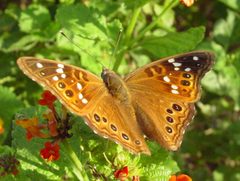
Asterocampa leilia, commonly known as the Empress Leilia or desert hackberry, is a medium-sized (Nymphalidae) native to the southwestern United States and Mexico. are brownish-orange with distinctive white and black spots on the wing surfaces. The is closely associated with hackberry (Celtis) plants and exhibits notable behavioral adaptations for mate location, including perching and patrolling strategies. Males engage in territorial defense and behavioral at sunlit perching sites.

Pronunciation
How to pronounce Asterocampa leilia: /ˌæstɛroʊˈkæmpə ˈlaɪliə/
These audio files are automatically generated. While they are not always 100% accurate, they are a good starting point.
Identification
Distinguished from similar Asterocampa by its brownish-orange coloration and specific spot pattern on the wing surfaces. The Empress Leilia can be separated from the Tawny Emperor (Asterocampa clyton) and Hackberry Emperor (Asterocampa celtis) by geographic range and subtle differences in wing pattern and coloration. In the southwestern U.S., it is the primary Asterocampa species in desert .
Images
Appearance
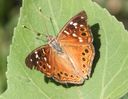
are brownish-orange in coloration. The wing surfaces display distinctive white and black spots. Wingspan ranges from 1.5 to 2 inches (38–51 mm). The overall coloration provides camouflage when wings are closed, with the spotted pattern visible on the underside.
Habitat
Occurs in desert environments including canyons, streamsides, thorn scrub, and washes. Strongly associated with hackberry (Celtis) plants, which serve as larval food sources and as perching sites for mate-locating males. Requires access to moisture sources such as stream margins for puddling .
Distribution
Southwestern United States (Arizona, Texas) and Mexico. The occupies arid and semi-arid regions within this range.
Diet
feed primarily on non-floral liquid sources including , sap, and rotten fruit. Nectar feeding occurs only rarely. Larvae feed exclusively on hackberry (Celtis spp.) foliage.
Host Associations
- Celtis - larval plantHackberry ; serves as food for larvae and perching sites for males
Life Cycle
Complete with , larva, pupa, and stages. Larvae feed on hackberry leaves. Specific details of site and stage not documented in available sources.
Behavior
Males employ two primary mate-locating tactics: perching (waiting at vantage points on plants for passing females) and patrolling (actively flying through to search for females). Males exhibit behavioral at perching sites, adjusting body posture and wing orientation to maintain optimal thoracic temperature for rapid takeoff. Territorial defense involves aerial pursuits and physical interactions with intruding males. , particularly males, engage in puddling at moist soil along stream margins to obtain minerals.
Ecological Role
Larval herbivore on hackberry; contributes to nutrient cycling through larval feeding. may facilitate nutrient transfer through puddling and subsequent . Serves as prey for various including birds and insects.
Human Relevance
Subject of ecological and behavioral research, particularly regarding mate-locating strategies and . Occasionally observed by enthusiasts in the southwestern U.S. Not considered an agricultural pest.
Similar Taxa
- Asterocampa clytonTawny Emperor; occurs in eastern and central U.S., overlapping in Texas; differs in wing pattern details and preference (more mesic environments)
- Asterocampa celtisHackberry Emperor; more widespread in eastern U.S.; differs in distribution and subtle wing pattern characteristics
More Details
Behavioral Research Significance
Asterocampa leilia has been extensively studied as a model organism for understanding male mate-locating and behavioral in butterflies. Research has documented the plasticity of perching versus patrolling strategies and the importance of microclimate selection for reproductive success.
Sources and further reading
- BugGuide
- Wikipedia
- GBIF taxonomy match
- iNaturalist taxon
- NCBI Taxonomy
- Catalogue of Life
- Bug Eric: September 2010
- Bug Eric: Mother (Nature's) Day in Madera Canyon
- Mutillidae | Beetles In The Bush
- December | 2013 | Beetles In The Bush | Page 2
- Lepidoptera | Beetles In The Bush | Page 6
- Behavioural thermoregulation at mate encounter sites by male butterflies (Asterocampa leilia, Nymphalidae)
- Male mate-locating behavior in the desert hackberry butterfly, Asterocampa leilia (Nymphalidae)
- Behavior of male desert hackberry butterflies, Asterocampa leilia (Nymphalidae) at perching sites used in mate location