
Asterocampa clyton
(Boisduval & Le Conte, 1833)
tawny emperor
Species Guides
4- Asterocampa clyton clyton(Eastern Tawny Emperor)
- Asterocampa clyton flora(Florida Tawny Emperor)
- Asterocampa clyton louisa
- Asterocampa clyton texana(Texan Emperor)
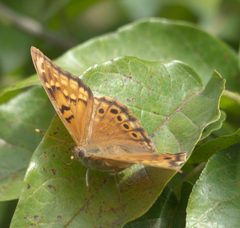
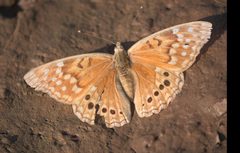
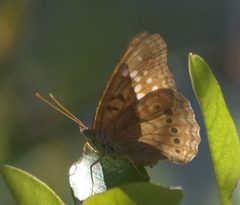
Asterocampa clyton, the tawny emperor, is a native to eastern North America. are distinguished from the similar hackberry emperor by orange-brown forewings with pale orange-yellow spots and the absence of white forewing spots and a lower black eyespot. The exhibits a dark morph with nearly uniformly dark hindwings in some regions. Adults rarely visit flowers, instead feeding on carrion, plant sap, and . The sole larval is hackberry (Celtis spp.).
Pronunciation
How to pronounce Asterocampa clyton: /ˌæstɛroʊˈkæmpə ˈklaɪtɒn/
These audio files are automatically generated. While they are not always 100% accurate, they are a good starting point.
Identification
Distinguished from the hackberry emperor (Asterocampa celtis) by: (1) absence of white spots near the tip of the forewing, (2) absence of a black eyespot lower along the edge of the forewing. The tawny emperor has orange-brown forewings with pale orange-yellow spots, while the hackberry emperor shows more contrasting white spotting. Dark morph individuals may be confused with other dark butterflies but retain the characteristic forewing pattern when viewed closely.
Images
Appearance
Wingspan 51–66 mm (2.0–2.6 in). Upperside predominantly dark brown; forewing orange-brown with pale orange-yellow spots. Underside gray-brown with black and pale yellowish markings on forewing. Dark morph regionally common with nearly uniformly dark hindwings. Distinguished from Asterocampa celtis (hackberry emperor) by absence of white spots near forewing tip and absence of black eyespot lower along forewing edge.
Habitat
Found near houses, gravel driveways, water sources, muddy areas, gardens, and woodlands. Strongly associated with hackberry trees (Celtis spp.), the sole larval plant. congregate at sap flows on trees, particularly on stressed or diseased hardwoods.
Distribution
Native to North America, primarily the eastern half from Canada to northern Mexico. Eastern United States and southeastern Canada, extending westward into the Great Plains and south into Mexico.
Diet
feed on carrion, plant sap, and . Rarely observed visiting flowers. Larvae feed exclusively on hackberry (Celtis spp.) leaves.
Host Associations
- Celtis - larval plantsole ; laid on leaves, larvae feed on foliage
Life Cycle
Female lays clusters of green on hackberry leaves. Larva is green with yellow, white, or greenish stripes. details not specified in available sources. Multiple per year in southern portions of range, fewer in north.
Behavior
frequently congregate at sap flows on tree trunks, often in mixed- with beetles, flies, and other butterflies. Adults are not skittish when feeding at sap flows and reluctant to leave. Males perch and patrol for females. Adults are strong fliers.
Ecological Role
Larval herbivore on hackberry trees. serves as a non-pollinating visitor to sap flows, contributing to nutrient cycling through carrion and feeding. subject to by surface-parasitizing ; egg mass design may represent defensive .
Human Relevance
Occasional visitor to gardens and residential areas. Not an agricultural pest. Sometimes attracted to gravel driveways and muddy areas near human habitation. Of interest to watchers and photographers.
Similar Taxa
- Asterocampa celtisHackberry emperor; distinguished by white spots near forewing tip and black eyespot lower along forewing edge, which A. clyton lacks
More Details
Egg mass anti-parasitoid adaptations
Research indicates that mass characteristics in A. clyton may represent defensive adaptations against surface-parasitizing .
Dark morph
A regionally common dark morph with nearly uniformly dark hindwings occurs in some .
Subspecies
A. c. texana (Texas tawny emperor) occurs in the south-central United States and northern Mexico.
Sources and further reading
- BugGuide
- Wikipedia
- GBIF taxonomy match
- iNaturalist taxon
- NCBI Taxonomy
- Catalogue of Life
- Mutillidae | Beetles In The Bush
- December | 2013 | Beetles In The Bush | Page 2
- Lepidoptera | Beetles In The Bush | Page 6
- flies | Beetles In The Bush | Page 3
- Egg mass design relative to surface-parasitizing parasitoids, with notes on Asterocampa clyton (Lepidoptera: Nymphalidae)