
Callophrys polios
(Cook & Watson, 1907)
Hoary Elfin
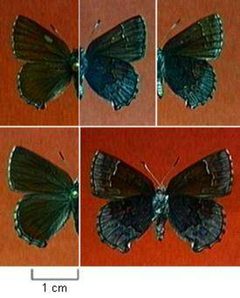
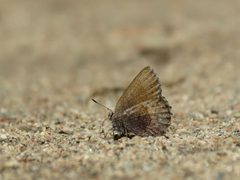
Callophrys polios, the hoary elfin, is a small in the Lycaenidae with a wingspan of 22–29 mm. It is a northern associated primarily with pine-oak barrens and other open . The species has a broad but patchy distribution across North America, from Alaska and Canada south through the Great Lakes, New England, Appalachians, Rocky Mountains, and Pacific Coast to northern California. are active in spring, with a single from April to June. The species is listed as a species of special concern and believed extirpated in Connecticut.
Pronunciation
How to pronounce Callophrys polios: /ˈkæləfrɪs ˈpoʊliˌɑs/
These audio files are automatically generated. While they are not always 100% accurate, they are a good starting point.
Identification
Distinguished from other elfin (Callophrys) by its grayish rather than brown coloration and the relatively straight postmedian line on the underside of the hindwing. Frosted elfin (C. irus) has more brown tones and a more irregular wing pattern. Henry's elfin (C. henrici) shows stronger brown coloration and more pronounced pattern elements. Brown elfin (C. augustinus) is darker brown with more rounded wings. association provides additional context: C. polios is a northern of pine-oak barrens, while occupy different or geographic zones.
Images
Habitat
Pine-oak barrens and other open, dry with sandy or rocky soils. In central Wisconsin, strongly associated with barrens habitats. Occurs in areas supporting its larval plants, particularly bearberry (Arctostaphylos uva-ursi).
Distribution
North America: Alaska and northern Canada (Alberta, Manitoba, Saskatchewan) south through Great Lakes states, New England (Maine to New Jersey), Appalachian Mountains to Virginia, Rocky Mountains to northern New Mexico, and Pacific Coast to northern California. Distribution is broad but patchy and localized; extirpated from Connecticut.
Seasonality
active April to June in one per year. First observed dates have trended earlier over time in some regions. period overlaps with other spring elfin .
Diet
Larvae feed on bearberry (Arctostaphylos uva-ursi) and possibly trailing arbutus (Epigaea repens). feed on flower nectar from leatherleaf (Chamaedaphne calyculata), pyxie (Pyxidanthera barbulata), wild strawberry (Fragaria spp.), and willow (Salix spp.).
Host Associations
- Arctostaphylos uva-ursi - larval food plantPrimary ; verified larval feeding
- Epigaea repens - possible larval food plantSuspected ; not definitively confirmed
Life Cycle
Complete with four stages: , larva, pupa (chrysalis), . Single per year (). Hibernation occurs as chrysalis. Adults emerge in spring.
Behavior
fly in spring, with period overlapping other elfin . co-varies with frosted elfin (C. irus) and other . In central Wisconsin, abundance correlates positively with previous year's growing season precipitation.
Ecological Role
of early spring flowers including leatherleaf, pyxie, wild strawberry, and willow. Larval herbivore on bearberry. Component of pine-oak barren , serving as prey for birds and other .
Human Relevance
Subject of conservation concern; listed as of special concern and believed extirpated in Connecticut. Included in long-term monitoring programs, particularly in Wisconsin where 20-year survey data (1994–2013) document trends. for pine-oak barren quality.
Similar Taxa
- Callophrys irusFrosted elfin; more brown than gray, more irregular wing pattern, different preferences
- Callophrys henriciHenry's elfin; stronger brown coloration, more pronounced pattern elements, southern distribution
- Callophrys augustinusBrown elfin; darker brown, more rounded wings, broader distribution
More Details
Climate Correlations
In central Wisconsin, abundance positively correlated with previous year's growing season precipitation. First observed dates trended earlier over time (r = −0.2495 with year), though not statistically significant when analyzed alone. period span increased with earlier first observed dates.
Subspecies
Three recognized: C. p. polios (nominate), C. p. obscura (Colorado), and C. p. maritima (California). Subspecies obscura and maritima were described relatively recently (1973 and 1998, respectively).
Conservation Status
Listed as of special concern in Connecticut, where believed extirpated. Long-term monitoring in Wisconsin suggests stable to increasing trends in protected reserves compared to non-reserve areas.