
Callophrys irus
(Godart, 1824)
Frosted Elfin
Species Guides
3- Callophrys irus arsace
- Callophrys irus hadros(Frosted Elfin)
- Callophrys irus irus(Frosted Elfin)
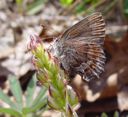
Callophrys irus, the frosted elfin, is a rare Lycaenid to fire-maintained in eastern North America. are small with brown forewings and frosted gray hindwings with a short tail. The has declined across much of its range, with many now isolated and some presumed extirpated. It is listed as threatened or endangered in multiple eastern U.S. states.
Pronunciation
How to pronounce Callophrys irus: //kəˈlɒf.rɪs ˈaɪ.rəs//
These audio files are automatically generated. While they are not always 100% accurate, they are a good starting point.
Identification
Distinguished from other elfins by combination of frosted gray hindwing underside, short single tail, and brown upper surface. Baptisia-feeding tend to be larger and darker; lupine-feeding populations smaller and paler. May be confused with other Callophrys but frosted gray coloration on hindwing underside is distinctive.
Images
Habitat
Historically found in natural barrens, grassy openings, and savannahs. Now primarily occupies human-maintained early successional including powerline corridors, gravel roads, and railroad rights-of-way. Requires sandy, well-drained soils. prefer open areas with partial tree cover; larvae develop best in areas with close to partial . Needs some shade and tree cover to survive; adults move toward shade during hot conditions.
Distribution
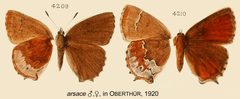
Eastern North America from southern Ontario and Maine west to Wisconsin, south along Atlantic Coast to Louisiana and eastern Texas. Three putative described: C. i. irus (most widespread), C. i. hadros (southwest), and C. i. arsace (coastal Carolinas). Extirpated or possibly extinct in Canada, Maine, and Illinois; no confirmed extant of C. i. arsace found in recent surveys.
Seasonality
One period annually. Southern : March to April. Northern populations: mid-May to early June. Non-migratory; completes entire within one year.
Diet
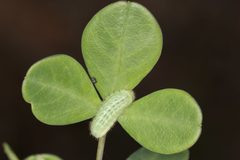
Larvae feed on flowers and developing seedpods of plants in Fabaceae. Documented hosts include wild indigo (Baptisia tinctoria), lupine (Lupinus perennis), and rattlebox (Crotalaria sagittalis). specialize on either Baptisia or Lupinus; no observed switching between host types. feed on nectar from various flowers.
Host Associations
- Baptisia tinctoria - larval plantwild indigo; primary for eastern
- Lupinus perennis - larval plantlupine; primary for northern and some southern
- Crotalaria sagittalis - larval plantrattlebox; documented
Life Cycle
. Females lay singly on flower buds of plant. Larvae progress through four instars, feeding on flowers and developing seedpods. occurs by late July in northeast; pupae enter and overwinter in loose cocoons in leaf litter or just below soil surface (typically <1.75 cm depth). emerge following spring. Hibernation as pupa is primary strategy.
Behavior
remain close to plants. When temperatures rise, adults move toward shaded areas. Larvae burrow to pupate, though burrowing is variable among individuals. Non-migratory; limited. Tolerates season or late summer mowing but not spring mowing or frequent prescribed burns.
Ecological Role
as . Larval herbivore on Fabaceae, with potential role in nutrient cycling in early successional . Serves as for fire-maintained barrens and sandplain .
Human Relevance
Subject of conservation concern due to declines and loss. Listed as threatened or endangered in Connecticut, New York, Michigan, and other states; no federal protection. Management conflicts arise between prescribed fire needs for habitat maintenance and fire mortality risk to pupae. or reintroduction considered viable due to lack of strong genetic population structure.
Similar Taxa
- Other Callophrys elfinsSimilar size and general ; distinguished by hindwing underside coloration and pattern
- Callophrys gryneus (Juniper Hairstreak)Overlaps in range; differs in green coloration and plant associations
Misconceptions
Three (C. i. irus, C. i. hadros, C. i. arsace) were described based on and use, but genetic analysis found no evidence of differentiation by host plant or clear genetic distinction among putative subspecies. The reported subspecies C. i. arsace has not been confirmed extant despite targeted surveys.
More Details
Fire Management
Pupae suffer high mortality from fire, with survival decreasing sharply at shallower burial depths (0% survival at 0.75 cm, 60% at 1.75 cm). Fire practitioners should use mosaic burn patterns, suboptimal burn conditions, or rotational schedules to ensure survival while maintaining plant .
Conservation Genetics
Range-wide genetic analysis found subtle geographic clustering in mitochondrial but no -plant associated genetic structure. Lack of genetic differentiation suggests reintroduction efforts could succeed if regionally local, though unique haplotypes in far northern, southern, and western ranges should be considered.
Habitat Occupancy
patch area is strongest predictor of occupancy; probability increases 7% per additional hectare. occupied patch area is 1.31 hectares. plant abundance correlates with habitat area.
Sources and further reading
- BugGuide
- Wikipedia
- GBIF taxonomy match
- iNaturalist taxon
- NCBI Taxonomy
- Bug Eric: Year-end Wrap-up
- Bug Eric: City Nature Challenge 2023 Recap
- How Beekeepers Can Foster Propolis Production for Better Hive Health
- Life History Observations of Callophrys irus (Family: Lycaenidae) in North Florida, USA
- Conservation genetics and habitat occupancy modeling for the frosted elfin butterfly, Callophrys irus
- Distribution and Habitat Preferences of a Frosted Elfin Subspecies (Callophrys irus hadros, Lycaenidae) in Arkansas
- Pupae survival following fire in the frosted elfin ( Callophrys irus )
- Dispersal, population size, and reproduction in a fire-maintained frosted elfin (Callophrys irus) metapopulation
- Habitat characteristics of adult frosted elfins (Callophrys irus) in sandplain communities of southeastern Massachusetts, USA
- The effect of soil moisture and ambient temperature on pupation depth for the imperiled Callophrys irus
- Microhabitat use by larvae and females of a rare barrens butterfly, frosted elfin (Callophrys irus)