
Callophrys henrici
(Grote & Robinson, 1867)
Henry's elfin, woodland elfin
Callophrys henrici, commonly known as Henry's elfin or woodland elfin, is a small North American in the Lycaenidae. The exhibits distinct groups with different plant associations: Atlantic Coast populations feed on various hollies (Ilex species), while northern and Appalachian populations use redbud (Cercis canadensis). The species has shown recent range expansion in New England due to adoption of introduced common buckthorn (Rhamnus cathartica) as a host plant. It is listed as a species of special concern in Connecticut.
Pronunciation
How to pronounce Callophrys henrici: /kəˈlɒfrɪs hɛnˈraɪsaɪ/
These audio files are automatically generated. While they are not always 100% accurate, they are a good starting point.
Identification
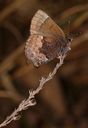
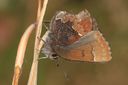
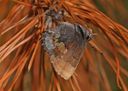
Distinguished from similar elfin (Callophrys irus, C. augustinus, C. polios) by: male lacks stigma (present in other species); short, stubby hindwing tails (absent in brown and hoary elfins); two-toned underside with limited frosting (frosted elfin has more extensive frosting; hoary elfin has completely frosted hindwing and forewing margins). Frosted elfin is slightly larger and usually has dark spot near hindwing outer margin. Brown elfin is more reddish-brown with no hindwing tails and no frosting.
Images
Habitat
Occupies diverse including barrens, coastal holly forests, open woodlands, and mesquite woodlands. Habitat use varies regionally and corresponds to plant availability.
Distribution
Canada: southern Manitoba to southern Nova Scotia. United States: two main groups—(1) Atlantic Coast from New England southward, and (2) northern states and Appalachian region. Expanding in New England due to introduced plant availability.
Seasonality
period varies by latitude: early May to early June in northern range; March to April in southern range. Single per year.
Diet
Larva feeds on flower buds and leaves of plants. Documented host plants include: Cercis canadensis (redbud), Ilex cassine (dahoon holly), Ilex opaca (American holly), Ilex vomitoria (yaupon holly), Rhamnus cathartica (introduced common buckthorn), Rhamnus frangula (black buckthorn), Ungnadia speciosa (Mexican buckeye), Vaccinium , and Viburnum species including V. acerifolium (maple-leaf viburnum).
Host Associations
- Cercis canadensis - larval Primary in northern and Appalachian
- Ilex cassine - larval Atlantic Coast
- Ilex opaca - larval Atlantic Coast
- Ilex vomitoria - larval Atlantic Coast
- Rhamnus cathartica - larval Introduced ; facilitating range expansion in New England
- Rhamnus frangula - larval
- Ungnadia speciosa - larval
- Vaccinium - larval -level record
- Viburnum acerifolium - larval
- Viburnum - larval -level record
Life Cycle
One per year. laid singly on plant flower buds or leaves near buds; eggs pale green, turning whitish before hatching. Larva highly variable in color: greenish yellow to red-brown to maroon, with variable spots (white, yellow, green, or red-green) and lateral stripe (yellow or reddish); some individuals with faint yellow or reddish stripe. Pupa orange-brown, mottled with dark brown-black, hibernates in leaf litter.
Behavior
Males perch at approximately human level to await females, though sometimes perch high in tree tops or very low to ground.
Ecological Role
Herbivore; larval feeding on plant buds and leaves. of food plants. Prey for various .
Human Relevance
Subject of conservation concern in Connecticut (listed as of special concern). Used as for quality in coastal holly forests and barrens. Range expansion in New England linked to human-mediated introduction of Rhamnus cathartica.
Similar Taxa
- Callophrys irus (frosted elfin)Slightly larger; male has stigma; more extensive hindwing frosting; usually has dark spot near hindwing outer margin.
- Callophrys augustinus (brown elfin)More reddish-brown; male has stigma; lacks hindwing tails; underside of hindwing has no frosting.
- Callophrys polios (hoary elfin)Smaller; male has stigma; lacks hindwing tails; underside of hindwing outer margin completely frosted; forewing outer margin also frosted.
More Details
Population Structure
The comprises two distinct ecological races in the United States: Atlantic Coast associated with Ilex species, and northern/Appalachian populations associated with Cercis canadensis. This plant divergence may represent incipient ecological speciation.
Conservation Status
Listed as of special concern in Connecticut. Increasing in New England due to novel plant association with introduced Rhamnus cathartica, representing a rare case of rapid to plant facilitating range expansion.