
Callophrys augustinus
(Westwood, 1852)
Brown Elfin, Western Elfin (subspecies iroides)
Callophrys augustinus, the brown elfin, is a small lycaenid with a wingspan of 22–29 mm. are active in a single from early May to early June. The is with pupal hibernation. Larvae feed on Ericaceae species in eastern North America and a broader range of plants in western .
Pronunciation
How to pronounce Callophrys augustinus: //kəˈlɒfrɪs ɔːˈɡʌstɪnəs//
These audio files are automatically generated. While they are not always 100% accurate, they are a good starting point.
Identification
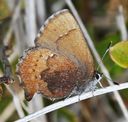
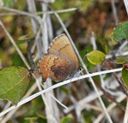
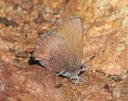
Distinguished from other North American elfins (Callophrys ) by combination of brown upper wing coloration and the W-shaped white postmedian line on the hindwing underside. The western C. a. iroides occurs in different geographic range than eastern . Similar species include Henry's elfin (Callophrys henrici) and frosted elfin (Callophrys irus), which differ in plant associations and subtle wing pattern details.
Images
Appearance
Small with wingspan 22–29 mm. Upper wing surfaces brown. Underside hindwing typically shows a white postmedian line forming a W-shape or zigzag pattern, a characteristic feature of elfin butterflies in this . clubbed with white rings.
Habitat
Occupies forested and shrubland . Eastern associated with Vaccinium and Ledum groenlandicum in acidic, often boggy woodlands. Western populations found in more varied habitats including chaparral and woodland edges with Arbutus and Cuscuta plants.
Distribution
Transcontinental in northern North America. From Newfoundland west through prairie provinces to Alaska. Southward in Appalachians to northern Georgia and Alabama, and through western cordillera to northern Baja California, Mexico. iroides restricted to Pacific coastal region from British Columbia to California and Baja California.
Seasonality
on wing early May to early June in one . . Pupae overwinter, with adults emerging in spring.
Diet
Larvae feed on flowers and fruits of plants. Eastern : Vaccinium vacillans, Ledum groenlandicum (Ericaceae). Western populations: Arbutus , Cuscuta species, and other plants. feed on nectar from diverse flowers including Vaccinium, Sanicula arctopoides, Lindera, Salix, Barbarea, and Prunus americana.
Host Associations
- Vaccinium vacillans - larval food planteastern
- Ledum groenlandicum - larval food planteastern
- Arbutus - larval food plantwestern
- Cuscuta - larval food plantwestern
Life Cycle
Complete with four stages: , larva, pupa, . occurs in leaf litter at base of plant. Hibernation as pupa. Single per year.
Behavior
visit flowers for nectar. Larvae feed specifically on reproductive structures (flowers and fruits) rather than foliage. period relatively brief and synchronized across .
Ecological Role
function as when nectaring. Larvae act as specialized herbivores on Ericaceae and other flowering plants, potentially influencing seed production of .
Human Relevance
Subject of long-term monitoring studies, including Art Shapiro's 42-year survey in California's Central Valley. iroides has been documented as appearing earlier in the season in recent years, with observations on January 25, 2014 at Gates Canyon, Vacaville representing the earliest recorded date for that site.
Similar Taxa
- Callophrys henriciHenry's elfin; similar size and appearance but associated with different plants (primarily Celtis and Rhamnus)
- Callophrys irusFrosted elfin; with more restricted range, hindwing underside pattern differs
- Callophrys gryneusJuniper hairstreak; green coloration on wings, different plant (Juniperus)
More Details
Taxonomic history
First collected by John Richardson in 1827. Specific epithet augustinus honors Inuit interpreter Tatannuaq, also known as 'Augustus'. Formerly placed in Incisalia, now synonymized with Callophrys.
Subspecies
Recognized include C. a. augustinus (Canada), C. a. iroides (Pacific coast, known as western elfin), C. a. annettae (New Mexico), C. a. concava (Nevada), C. a. croesioides (Canada), and C. a. helenae (Newfoundland).