
Callophrys mossii
(Edwards, 1881)
Moss's elfin, stonecrop elfin, Schryver's elfin
Species Guides
1- Callophrys mossii bayensis(San Bruno Elfin)
Callophrys mossii is a small North American in the Lycaenidae, commonly known as Moss's elfin, stonecrop elfin, or Schryver's elfin. It is distributed in isolated from British Columbia south to southern California and east to Wyoming and Colorado. The is , with active from March to June. Larvae are specialized feeders on stonecrop family plants (Crassulaceae), particularly Sedum, Sedella, Dudleya, and Parvisedum species. Multiple have been described, reflecting geographic isolation across its range.
Pronunciation
How to pronounce Callophrys mossii: /kəˈlɒfrɪs ˈmɒsi.aɪ/
These audio files are automatically generated. While they are not always 100% accurate, they are a good starting point.
Identification
Distinguished from other Callophrys by its small size, early spring period, and association with rocky containing stonecrop plants. Overlaps geographically with Western Green Hairstreak (Callophrys affinis) and Juniper Hairstreak (Callophrys gryneus), but C. mossii is smaller and flies earlier in the season. wing pattern differs from C. affinis in having less prominent green coloration. identification requires examination of specific geographic location and subtle wing pattern differences; several California subspecies are restricted to single mountain ranges or islands.
Images
Appearance
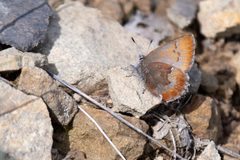
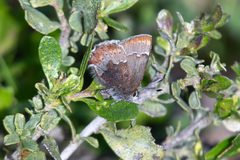
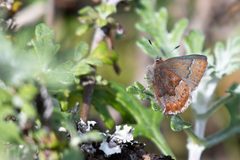
Small with wingspan of 22–28 mm. have relatively short, rounded wings typical of elfin butterflies. wing surfaces are generally brownish-gray with limited patterning. surfaces show more complex markings, often with greenish or grayish tones and fine striations that provide camouflage against rocky substrates. are short with clubbed tips. Body is compact and densely scaled.
Habitat
Rocky outcrops, woody canyons, and cliff . Strongly associated with patches of stonecrop plants (Crassulaceae) growing in thin soils on rock surfaces. Elevational range varies by latitude, from sea level in British Columbia to montane zones in interior . are often dry, exposed, and subject to temperature extremes.
Distribution
Native to western North America. Range extends from Vancouver Island and coastal British Columbia south through Washington, Oregon, and California to southern California, with isolated interior in Wyoming and Colorado. Discontinuous distribution with populations often restricted to specific mountain ranges or coastal bluffs.
Seasonality
are active from March to June. Single per year (). timing varies with elevation and latitude, with coastal emerging earlier than montane interior populations. stage is pupal.
Diet
Larvae feed on stonecrop plants (Crassulaceae), specifically Sedum (including S. spathulifolium and S. lanceolatum), Sedella, Dudleya, and Parvisedum. diet is not well documented; adults have been observed visiting flowers and damp ground for moisture and minerals.
Host Associations
- Sedum spathulifolium - larval documented larval foodplant
- Sedum lanceolatum - larval documented larval foodplant
- Sedella - larval -level association
- Dudleya - larval -level association
- Parvisedum - larval -level association
Life Cycle
Complete with four stages: , larva, pupa, . Eggs are laid on plant leaves or stems. Larvae feed on succulent leaves of stonecrop plants, likely concealed within foliage. occurs in debris or soil at base of host plant. Overwinters as pupa. Single per year with adults emerging in spring.
Behavior
fly low and erratically near plant patches. Perching on rocks and bare ground is common. Males likely patrol territories near host plants seeking females. Early spring coincides with host plant growth and flowering.
Ecological Role
of early spring flowers in rocky . Larval herbivore on native stonecrop plants. Serves as prey for birds, spiders, and predatory insects. Specialized association with Crassulaceae contributes to plant-insect in western North American rocky .
Human Relevance
Subject of conservation concern for some due to restricted ranges and specificity. The San Bruno elfin (C. m. bayensis) has been a focus of conservation efforts in the San Francisco Bay Area. Popular among enthusiasts and photographers for its early period and accessible rocky habitat locations. No known agricultural or economic significance.
Similar Taxa
- Callophrys affinisOverlaps in range and ; larger size (wingspan 25–32 mm), more prominent green coloration, and later period (May–July) distinguish it from C. mossii
- Callophrys gryneusJuniper Hairstreak overlaps in some areas; associated with juniper trees rather than stonecrop plants, has more green coloration on wings, and different plant (Cupressaceae)
- Callophrys dumetorumBramble Hairstreak has similar size but different preferences (coastal scrub, chaparral) and plants (Rhamnaceae); wing patterns differ in detail
More Details
Subspecies diversity
Seven recognized, reflecting geographic isolation: C. m. mossii (Vancouver Island), C. m. bayensis (San Bruno elfin, San Francisco Bay Area), C. m. doudoroffi (California), C. m. hidakupa (California), C. m. marinensis (California), C. m. schryveri (Colorado), and C. m. windi (California). Several have extremely restricted ranges and may warrant conservation attention.
Taxonomic history
Originally described as Thecla irus var. mossii by Edwards in 1881. Transferred to Callophrys based on morphological and molecular studies of Lycaenidae relationships.