
Callophrys mossii bayensis
R. Brown, 1969
San Bruno Elfin
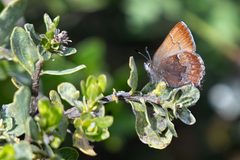
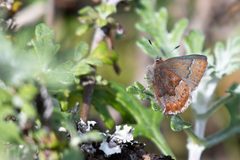
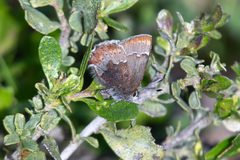
The San Bruno Elfin is a federally endangered to the San Francisco Peninsula in California. It inhabits rocky outcrops and cliffs in coastal scrub , with its distribution directly tied to that of its plant, broadleaf stonecrop (Sedum spathulifolium). The subspecies was described by R. Brown in 1969 and is currently listed under the U.S. Act.
Pronunciation
How to pronounce Callophrys mossii bayensis: /kæˈlɒfrɪs ˈmɒsi.aɪ bəˈjɛnsɪs/
These audio files are automatically generated. While they are not always 100% accurate, they are a good starting point.
Identification
Distinguished from other Callophrys mossii by its restricted range on the San Francisco Peninsula; separation from sympatric hairstreaks requires examination of wing pattern details and association with rocky coastal scrub.
Images
Habitat
Rocky outcrops and cliffs in coastal scrub; quality depends on presence of plant Sedum spathulifolium.
Distribution
to the San Francisco Peninsula, California, USA; distribution is patchy and coincides with plant occurrence.
Diet
Larvae feed exclusively on broadleaf stonecrop (Sedum spathulifolium); food sources not documented in available sources.
Host Associations
- Sedum spathulifolium - larval plantbroadleaf stonecrop; required for larval development
Human Relevance
Listed as endangered under the U.S. Act; conservation status reflects loss and restricted range.
Similar Taxa
- Callophrys mossiiother of the same , distinguished by geographic separation and potentially subtle morphological differences
- Callophrys gryneussympatric juniper hairstreak with different plant association and preference
More Details
Conservation Status
U.S. federally listed endangered with protected at San Bruno Mountain and other localities
Taxonomic History
Described by R. Brown in 1969 as a distinct based on geographic isolation and plant specialization