
Callophrys affinis
(Edwards, 1862)
Western Green Hairstreak, Immaculate Green Hairstreak
Species Guides
3- Callophrys affinis affinis(Western Green Hairstreak)
- Callophrys affinis apama(Western Green Hairstreak)
- Callophrys affinis homoperplexa(Western Green Hairstreak)
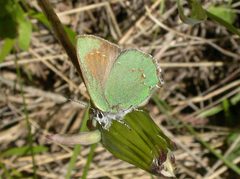
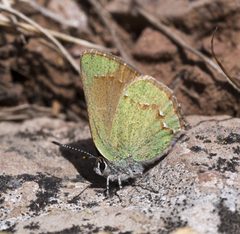
Callophrys affinis is a small in the Lycaenidae, commonly known as the western green or green hairstreak. It is found in western North America from western Canada through the western United States. fly in a single from early spring to mid-summer. The larvae feed specifically on Eriogonum umbellatum.
Pronunciation
How to pronounce Callophrys affinis: /kæˈlɒfrɪs əˈfaɪnɪs/
These audio files are automatically generated. While they are not always 100% accurate, they are a good starting point.
Identification
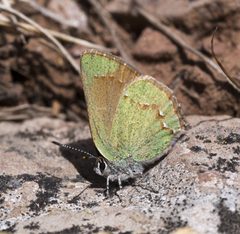
Wingspan 20–28 mm. Upper wing surfaces are brownish-gray. Underside of hindwing is bright metallic green with a thin white postmedian line, lacking the distinct spotting or reddish-brown markings found in related Callophrys such as C. rubi or C. dumetorum. The combination of green underside with minimal markings distinguishes this species from other green hairstreaks in its range.
Images
Habitat
Open, sunny including sagebrush steppe, pinyon-juniper woodlands, montane meadows, and rocky slopes. Often associated with areas where the larval plant Eriogonum umbellatum grows.
Distribution
Western Canada (British Columbia, Alberta) and western United States (Washington, Oregon, California, Nevada, Idaho, Montana, Wyoming, Colorado, Utah, Arizona, New Mexico).
Seasonality
are active from early March to mid-June in one per year. Timing varies with elevation and latitude, with lower elevations and southern areas emerging earlier.
Diet
Larvae feed exclusively on Eriogonum umbellatum (sulfur-flower buckwheat). feeding habits are not documented in available sources.
Life Cycle
One per year. Larvae develop on plant and pupate; emerge the following spring. Specific details of site and stage are not documented in available sources.
Ecological Role
Larval herbivore on Eriogonum umbellatum. butterflies may contribute to pollination, though this has not been quantified. Serves as prey for various .
Human Relevance
Subject of conservation interest in some regions; included in inventory efforts in British Columbia. Attracted to observers due to its bright metallic green coloration.
Similar Taxa
- Callophrys rubiSimilar green underside, but C. rubi has more extensive white markings and reddish-brown spots near the wing margins; ranges overlap in some areas.
- Callophrys dumetorumAlso has green underside, but typically shows more prominent white markings and has different period; former under older classifications.
Sources and further reading
- BugGuide
- Wikipedia
- GBIF taxonomy match
- iNaturalist taxon
- NCBI Taxonomy
- Catalogue of Life
- Meet 'Mantis Master Keeper' Andrew Pfeifer | Bug Squad
- Saving the Rusty-Patched Bumble Bee | Bug Squad
- Bug Eric: Year-end Wrap-up
- Take 2 on tropical tiger moths: Spotted oleander caterpillar moth, Empyreuma affinis — Bug of the Week
- Mason bees in peril when parasitic wasps arrive – Leucospid wasp, Leucospis affinis — Bug of the Week
- A Tick that Feeds on Birds May Increase the Range of Lyme Disease