
Callophrys affinis apama
W.H. Edwards, 1882
Western Green Hairstreak
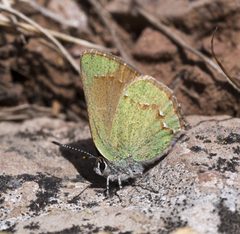
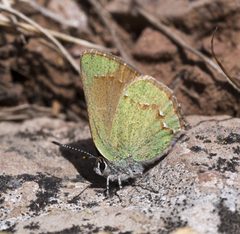
Callophrys affinis apama is a of the western green hairstreak , a small lycaenid found in western North America. It is one of several subspecies within the C. affinis complex, which shows geographic variation across its range. The is associated with open where its larval plants grow. are active in spring and early summer, with a rapid, low pattern typical of butterflies.
Pronunciation
How to pronounce Callophrys affinis apama: /kəˈlɒfrɪs əˈfɪnɪs əˈpeɪmə/
These audio files are automatically generated. While they are not always 100% accurate, they are a good starting point.
Identification
Distinguished from other by the predominantly green coloration of upper wing surfaces. C. affinis apama can be separated from other C. affinis by geographic range and subtle differences in wing pattern, though identification to subspecies level often requires locality data. Similar species include C. dumetorum (bramble hairstreak) and C. sheridanii (Sheridan's hairstreak), which differ in wing pattern details and geographic distribution. The green coloration separates it from gray or brown hairstreaks such as Satyrium species.
Images
Habitat
Open, sunny including grasslands, sagebrush steppe, open woodlands, and forest edges. Associated with areas supporting larval plants in the Ericaceae and Grossulariaceae . Elevation range extends from lowlands to subalpine zones depending on latitude.
Distribution
Western North America. The C. affinis apama occurs in the Rocky Mountain region and adjacent areas, with records from Colorado documented in the source material. The broader C. affinis ranges from western Canada through the western United States.
Seasonality
fly in spring and early summer, typically April to July depending on elevation and latitude. Single brooded in most of range; peak period varies with local climate conditions.
Diet
Larvae feed on in Ericaceae and Grossulariaceae, including manzanita (Arctostaphylos), currants (Ribes), and related shrubs. have been observed taking nectar from small flowers and visiting damp ground for moisture.
Host Associations
- Arctostaphylos - larval plantManzanita used as food source for larvae
- Ribes - larval plantCurrant and gooseberry
Life Cycle
Complete with four stages: , larva, pupa, . Eggs laid singly on plant buds or flowers. Larvae feed on host plant tissues, developing through several instars. occurs on or near host plant. stage varies; may be as egg or pupa depending on and locality. Adults emerge in spring.
Behavior
fly rapidly and close to the ground, often perching with wings closed. When perched, hindwing tails are often wagged to distract potential from the . Males establish territories and perch on prominent vegetation to await females. Both sexes visit flowers for nectar.
Ecological Role
of small flowers during period. Larvae serve as herbivores on shrubs. Prey for birds, spiders, and insect . Part of in western North American open .
Human Relevance
Subject of interest for watchers and collectors. Used as for quality in western . No significant economic impact; not considered a pest .
Similar Taxa
- Callophrys dumetorumSimilar size and but differs in wing pattern with more prominent white markings and less uniform green coloration
- Callophrys sheridaniiOverlapping range but differs in hindwing pattern details and typically occurs at higher elevations
- Satyrium speciesOther butterflies that differ in gray or brown coloration rather than green
More Details
Taxonomic status
GBIF lists C. affinis apama as a synonym of C. apama, indicating taxonomic uncertainty or reclassification in some treatments. The is part of a complex showing geographic variation across western North America that has been variously treated as subspecies or full by different authors.
Conservation
Not listed as threatened or endangered. loss from development and fire suppression may impact local . Climate change effects on montane and sagebrush habitats are potential concerns.
Sources and further reading
- BugGuide
- GBIF taxonomy match
- iNaturalist taxon
- NCBI Taxonomy
- Saving the Rusty-Patched Bumble Bee | Bug Squad
- Meet 'Mantis Master Keeper' Andrew Pfeifer | Bug Squad
- Take 2 on tropical tiger moths: Spotted oleander caterpillar moth, Empyreuma affinis — Bug of the Week
- Bug Eric: Year-end Wrap-up
- Mason bees in peril when parasitic wasps arrive – Leucospid wasp, Leucospis affinis — Bug of the Week
- A Tick that Feeds on Birds May Increase the Range of Lyme Disease