
Cyclargus thomasi
(Clench, 1941)
Miami blue, Caribbean blue, Thomas's blue
Cyclargus thomasi is a small blue in the Lycaenidae with a disjunct distribution across the Caribbean, Florida, and parts of North America. The C. t. bethunebakeri, known as the Miami blue, is to Florida and was federally listed as endangered in 2012. This subspecies has declined dramatically due to loss and now persists primarily in the Florida Keys. The exhibits myrmecophilous relationships with ants, particularly Florida carpenter ants, which protect caterpillars in exchange for sugary secretions.
Pronunciation
How to pronounce Cyclargus thomasi: //sɪˈklɑːrɡəs ˈθoʊməˌsaɪ//
These audio files are automatically generated. While they are not always 100% accurate, they are a good starting point.
Identification
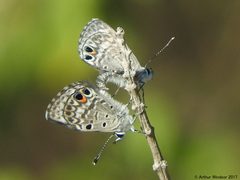
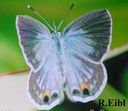
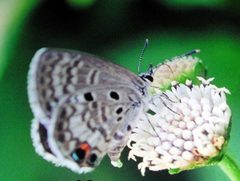
The Miami blue (C. t. bethunebakeri) can be distinguished from other Florida blues by its small size and restricted coastal . Males have bright blue upperwing surfaces; females are grayish-blue with dark margins. The undersides are gray with small dark spots and an orange marginal band on the hindwing. Accurate identification often requires examination of genitalia or geographic context given similarity to other Cyclargus .
Images
Habitat
Coastal areas including beach scrub, pine rocklands, and hammock edges. The Miami blue is associated with plants in the Florida Keys and has been reintroduced to Bahia Honda State Park. Requires areas where host plants and tending co-occur.
Distribution
Caribbean region, Florida (USA), and parts of North America. The nominate occurs in the West Indies. The subspecies C. t. bethunebakeri is restricted to Florida, historically throughout coastal areas but now limited primarily to the Florida Keys.
Diet
Larvae feed on leguminous plants including balloon vine (Cardiospermum corindum) and gray nickerbean (Caesalpinia bonduc). feed on nectar from various flowers.
Host Associations
- Cardiospermum corindum - larval plantballoon vine
- Caesalpinia bonduc - larval plantgray nickerbean
- Camponotus floridanus - mutualistFlorida carpenter ant; primary tending for Miami blue caterpillars
Life Cycle
Complete with , larva, pupa, and stages. Larvae pass through multiple instars, with later instars receiving more frequent tending. Ant-tended female larvae develop into larger pupae and produce more eggs as adults. occurs in leaf litter or other protected sites.
Behavior
Caterpillars possess a organ that secretes a sugary substance containing and other nutrients. This secretion attracts and rewards tending ants, which respond aggressively to . Ants drum their on caterpillars to solicit secretions. The mutualism is most effective with later instar larvae, which produce more secretions and receive greater protection.
Ecological Role
Participates in a mutualistic relationship with ants that enhances larval survival. As a herbivore, larvae influence plant dynamics in coastal . The endangered Miami blue serves as a flagship for Florida Keys conservation efforts.
Human Relevance
The Miami blue (C. t. bethunebakeri) is a federally listed , making it significant for conservation policy and protection. Captive breeding and reintroduction programs are ongoing. Conservation efforts focus on identifying release sites with appropriate associates, particularly Florida carpenter ants.
Similar Taxa
- Cyclargus ammonSimilar size and coloration; occurs in overlapping Florida range. Requires genital dissection or geographic context for reliable separation.
- Cyclargus dominicaCaribbean with similar blue upperwing coloration in males. Geographic separation is primary distinguishing feature.
- Hemiargus ceraunusAnother small Florida blue; differs in wing pattern details and lacks the Miami blue's specific association .
More Details
Conservation Status
Cyclargus thomasi bethunebakeri was listed as endangered under the U.S. Act in 2012. The crashed due to loss from coastal development, storm damage, and sea level rise. As of recent surveys, the wild population is restricted to a few islands in the Key West National Wildlife with reintroduction efforts at Bahia Honda State Park.
Ant Association Specificity
While Camponotus floridanus is the most common associate, 16 other ant have been observed tending Miami blue caterpillars. The effectiveness of protection varies among ant species and represents an active research area for conservation planning.