
Cyclargus
Nabokov, 1945
Species Guides
2- Cyclargus ammon(Nickerbean Blue)
- Cyclargus thomasi(Miami blue)
A of lycaenid butterflies established by Vladimir Nabokov in 1945, split from the genus Hemiargus. The genus contains several distributed across the Caribbean and southern Florida, including the critically endangered Miami blue (C. thomasi bethunebakeri). Taxonomic validity remains debated among lepidopterists.
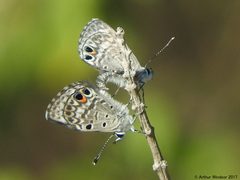
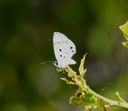
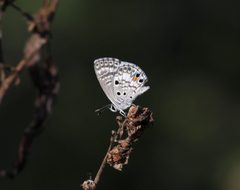
Pronunciation
How to pronounce Cyclargus: /sɪ.klɑr.ɡʊs/
These audio files are automatically generated. While they are not always 100% accurate, they are a good starting point.
Identification
Distinguished from the closely related Hemiargus by genitalic and wing pattern characteristics used by Nabokov in his 1945 revision. The genus-level separation is not universally accepted, and some lepidopterists continue to treat these as part of Hemiargus.
Images
Habitat
Coastal and island environments in the Caribbean region. The Miami blue (C. thomasi bethunebakeri) inhabits coastal scrub and beachside vegetation in the Florida Keys, particularly in the Key West National Wildlife and reintroduction sites at Bahia Honda State Park.
Distribution
Caribbean islands including Cuba, Jamaica, Hispaniola, Puerto Rico, the Bahamas, the Virgin Islands, and the Cayman Islands. In the United States, restricted to coastal southern Florida, primarily the Florida Keys.
Behavior
Caterpillars of at least one (C. thomasi bethunebakeri) engage in myrmecophily, a mutualistic relationship with ants. Larvae possess a organ that secretes a sugary substance rich in and nutrients, which attracts tending. Florida carpenter ants (Camponotus floridanus) and at least 16 other ant species have been observed tending Miami blue caterpillars. Ants provide protection against , with later instar larvae receiving more intensive tending than early instars. Ant-tended female larvae develop into larger pupae and produce more as .
Ecological Role
As a mutualist with ants, caterpillars contribute to nutrition through secretions while receiving protection services. The represents part of the lycaenid diversity in Caribbean island .
Human Relevance
The Miami blue (C. thomasi bethunebakeri) has been federally listed as endangered since 2012 and is critically endangered. Conservation efforts include captive breeding, reintroduction to Bahia Honda State Park, and planned mainland Florida reintroductions. Research on associations informs selection for release sites. The holds literary significance due to Nabokov's taxonomic work.
Similar Taxa
- HemiargusClosely related from which Cyclargus was split; separation based on genitalic and wing pattern differences, though not universally accepted by lepidopterists
Sources and further reading
- BugGuide
- Wikipedia
- GBIF taxonomy match
- iNaturalist taxon
- NCBI Taxonomy
- Catalogue of Life
- Camponotus floridanus-ants with Cyclargus thomasi bethunebakeri larva - Entomology Today
- Camponotus planatus ants with Cyclargus thomasi bethunebakeri larva - Entomology Today
- Cyclargus thomasi bethunebakeri adults - Entomology Today
- camponotus-floridanus-ants-with-cyclargus-thomasi-bethunebakeri-larva-socialmedia - Entomology Today
- Cyclargus thomasi bethunebakeri Archives - Entomology Today
- Amped-Up Ants: Caterpillars' Sugary Treats Earn Carpenter Ant Care