
Hemiargus ceraunus antibubastus
Hübner, 1818
Florida Blue
Hemiargus ceraunus antibubastus, commonly known as the Florida Blue, is a in the Lycaenidae. It is one of several subspecies of the Ceraunus blue, found primarily in Florida and the Florida Keys. The subspecies occurs in open including coastal areas, scrub, and disturbed sites. are active during warmer months and are associated with various legume plants.
Pronunciation
How to pronounce Hemiargus ceraunus antibubastus: //ˌhɛmiˈɑːrɡəs ˌsɛˈraʊnəs ˌæntɪbjuˈbæstəs//
These audio files are automatically generated. While they are not always 100% accurate, they are a good starting point.
Identification
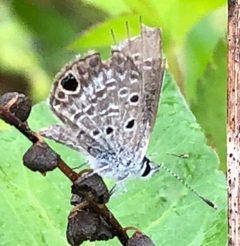
Distinguished from other Lycaenidae by combination of small size, blue upper wings (males), and gray undersides with dark spots and orange marginal markings. Separated from other Hemiargus by geographic occurrence in Florida and the Florida Keys. Similar to Reakirt's Blue (Hemiargus isola) but differs in spot pattern and distribution.
Images
Habitat
Open woodland edges, coastal scrub, dunes, pastures, road edges, vacant lots, and disturbed areas in subtropical and tropical regions
Distribution
Florida and the Florida Keys; to this region as the nominate H. c. ceraunus occurs elsewhere
Seasonality
Active year-round in southern Florida, with peak activity during warmer months; observed from spring through fall
Diet
Larvae feed on various legume including Fabaceae; feed on nectar from small flowers
Host Associations
- Fabaceae - larval plantVarious legume used as larval food plants
Life Cycle
Complete with , larva, pupa, and stages. Multiple per year in favorable climates. Larvae feed on plant tissues; occurs on or near host plants.
Behavior
are active fliers in open sunny areas. Males perch on low vegetation to await females. Adults frequently visit small flowers for nectar.
Ecological Role
of small flowers; serves as prey for various and vertebrate ; larval herbivore on native and introduced legumes
Human Relevance
Occasional garden visitor; of interest to watchers and collectors; for open conditions in Florida
Similar Taxa
- Hemiargus ceraunus ceraunusNominate occurring in southwestern US, Texas, and southward; distinguished by geographic separation and subtle morphological differences
- Hemiargus isolaReakirt's Blue, similar in size and general appearance but with different underside spot pattern and more western distribution
More Details
Taxonomic note
Hemiargus ceraunus antibubastus was described by Hübner in 1818. The is to Florida and the Florida Keys, while other subspecies occur in the southwestern United States, the West Indies, Mexico, Central America, and South America.