
Celastrina echo
(W.H. Edwards, 1864)
Echo Azure, Western Azure
Species Guides
4- Celastrina echo cinerea(Southwestern Azure)
- Celastrina echo echo(Pacific Azure)
- Celastrina echo nigrescens(Northwestern Azure)
- Celastrina echo sidara(echo azure)
Celastrina echo is a small blue in the Lycaenidae, native to western North America. Its taxonomic status was elevated from of C. ladon to full in 2001. The species exhibits complex associations with ants throughout its larval development and displays considerable variation in number depending on local climate conditions.
Pronunciation
How to pronounce Celastrina echo: /sɛˈlæstrɪnə ˈɛk.oʊ/
These audio files are automatically generated. While they are not always 100% accurate, they are a good starting point.
Identification
Distinguished from Celastrina ladon (Spring Azure) by geographic range—C. echo occurs west of the Great Plains. Separated from C. neglecta and other eastern azures by distribution and subtle differences in underwing spot pattern. identification requires examination of precise spot arrangement and geographic location.
Images
Appearance
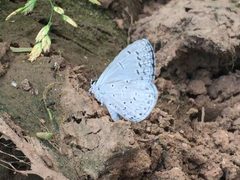
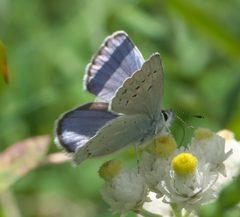
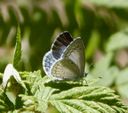
are small with wingspan typical of the . Upperwing surface is pale blue-grey. Underwings display small black spots or dashes. are hairy with ringed, club-like tips. Overall coloration is less vibrant than some related azure .
Habitat
Occupies woodlands, shrublands, and riparian corridors near mountain streams. Requires presence of woody plants, particularly Ceanothus . Found from low elevations to montane zones, with local distribution tied to moisture availability and host plant condition.
Distribution
Western North America: California, Oregon, Arizona, New Mexico, Montana, and adjacent regions of western Canada. Range corresponds to distribution of primary larval plants in western cordillera and associated foothills.
Seasonality
fly from early February through late June or July in most of range; extended into October possible in mild coastal or low-elevation areas without severe cold. Produces one to multiple annually depending on local moisture conditions and plant .
Diet
Larvae feed on flower buds and flowers of woody plants including Ceanothus (California wild lilac), Spiraea (Holodiscus), Aesculus (California buckeye), Rubus (blackberries), and selected legumes. nectar at flowers of larval plants plus Heteromeles (toyon), Rhamnus, and other available sources.
Host Associations
- Ceanothus - larval foodplantprimary
- Spiraea - larval foodplantincluding Holodiscus
- Aesculus - larval foodplantCalifornia buckeye
- Rubus - larval foodplantblackberries
- Heteromeles - nectar sourcetoyon
- Rhamnus - nectar source
Life Cycle
deposited on flower buds of plants. Larvae feed on buds and flowers, attended and protected by ants in exchange for honeydew secretions. may occur within nests. Specific pupal and details poorly documented.
Behavior
Larvae maintain mutualistic associations with ants throughout development, secreting honeydew in exchange for protection. are active fliers in sunny conditions, frequently visiting flowers for nectar. Males patrol for females in areas with plant concentrations.
Ecological Role
Larval herbivore on woody shrubs; contributes to pollination as nectar feeder. mutualism represents a notable component of interactions in occupied .
Human Relevance
Subject of taxonomic debate regarding boundaries, with elevation to full species status in 2001. Occasionally encountered by hikers and naturalists in western montane . No significant economic or agricultural impact documented.
Similar Taxa
- Celastrina ladonFormerly treated as ; distinguished by eastern North American distribution and subtle wing pattern differences
- Celastrina neglectaEastern azure with overlapping appearance; distribution separates the two
More Details
Taxonomic History
Originally described as Lycaena echo by W.H. Edwards in 1864. Treated as C. ladon echo by Layberry et al. in western Canada. Elevated to rank by Guppy and Shepard in 2001, now widely accepted. MONA/Hodges number 4363.2.
Subspecies
Five recognized with distinct geographic ranges: C. e. echo (Pacific azure), C. e. cinerea (Southwestern azure), C. e. nigrescens (Northwestern azure), C. e. sidara (Rocky Mountain azure), and C. e. gozora (Mexican Azure).
Ant Association Uncertainty
While larval attendance is well documented, the nature of late-stage and pupal associations remains unclear. Some Lycaenidae become parasitic or predatory in ant nests, but this has not been confirmed for C. echo.