
Hesperia pahaska
Leussler, 1938
Pahaska Skipper
Hesperia pahaska, commonly known as the Pahaska skipper, is a grassland in the Hesperiidae. It is distributed across a narrow longitudinal band in central North America, from Texas northward through the Great Plains to southern Canada. The is , with active in early summer. Larvae feed on specific native grasses including blue grama and fluff grass.
Pronunciation
How to pronounce Hesperia pahaska: /hɛˈspɛɹ.i.ə pəˈhæskə/
These audio files are automatically generated. While they are not always 100% accurate, they are a good starting point.
Identification
Distinguished from similar grassland skippers by its restricted geographic range and period. Differs from Hesperia comma and Hesperia leonardus by having less extensive pale markings on the underwings. The combination of small size, early summer flight, and prairie/grassland helps separate it from sympatric skippers. Male genitalia provide definitive identification.
Images
Appearance
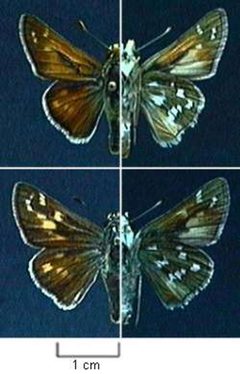
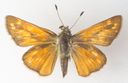
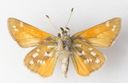
Wingspan 28–33 mm. A small to medium-sized skipper with typical Hesperia : stocky body, large , and with hooked clubs. Upper wing surfaces are orange-brown with dark brown markings; underwings are paler with subtle patterning. Males have a stigma (scent patch) on the forewing. The lacks the extensive pale spotting seen in some related Hesperia species.
Habitat
Occurs in dry grassland including desert grassland, chaparral, open woodland, and prairie hills. are characterized by native warm-season grasses and sparse to moderate vegetation cover. Elevational range extends from lowland plains to moderate elevations in hilly terrain.
Distribution
North America in a narrow belt extending from Texas northward through Oklahoma, Kansas, Nebraska, South Dakota, and North Dakota, reaching southern Canada in Saskatchewan and Manitoba. Absent from eastern and western portions of the continent.
Seasonality
fly from June to early July in the northern United States, with earlier in southern portions of the range. Single brooded ().
Diet
Larvae feed on blue grama (Bouteloua gracilis), fluff grass (Erioneuron pulchellum), Tridens pulchella, and other Poaceae . food sources are not documented in available sources.
Host Associations
- Bouteloua gracilis - larval food plantblue grama
- Erioneuron pulchellum - larval food plantfluff grass
- Tridens pulchella - larval food plant
- Poaceae - larval food plantgrass , unspecified
Life Cycle
Complete with , larva, pupa, and stages. Larvae feed on grass blades and stems. stage is the larva. occurs in spring, with adults emerging in early summer.
Behavior
are rapid, darting fliers typical of skippers. Males perch on low vegetation to await females. Both sexes visit flowers for nectar, though specific floral records are sparse. Larvae feed within grass blades, creating shelters by folding or tying leaves with silk.
Ecological Role
Larval herbivore on native grasses; contributes to grassland as prey for and . may serve as of grassland forbs, though this role is not quantified.
Human Relevance
Not of direct economic importance. Subject of interest for enthusiasts and conservation biologists monitoring prairie health. Potential for intact native grasslands.
Similar Taxa
- Hesperia commaOverlaps in range but has more extensive pale spots on underwings and different period in many areas
- Hesperia leonardusSimilar size and preference, but differs in wing pattern details and often has broader distribution
- Hesperia dakotaeAnother prairie with overlapping range; distinguished by specificity and subtle wing pattern differences
More Details
Subspecies
Three recognized: Hesperia pahaska pahaska (nominate), H. p. martini MacNeill, 1964, and H. p. williamsi Lindsey, 1940. Subspecies differ in minor wing pattern elements and geographic distribution.
Conservation Status
Not formally assessed by major conservation organizations, but dependent on intact native prairie that have declined significantly across its range.