
Autographa flagellum
(Walker, 1858)
Silver Whip Moth, Silver Whip
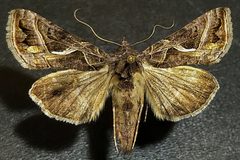
Autographa , commonly known as the Silver Whip, is a noctuid first described by Francis Walker in 1858. It occurs across southern Canada and the northern United States, with a single . are active during summer months, and larvae feed on specific plants in the Asteraceae .
Pronunciation
How to pronounce Autographa flagellum: /ɔːˈtɒɡrəfə fləˈɡɛləm/
These audio files are automatically generated. While they are not always 100% accurate, they are a good starting point.
Identification
The specific epithet '' (Latin for whip) refers to the distinctive silver marking on the forewing. Within the Autographa, identification to level requires examination of genitalia or detailed wing pattern analysis. The species can be distinguished from the more widespread Autographa gamma (Silver Y) by geographic range and subtle differences in wing markings.
Images
Habitat
Occurs in open supporting its larval plants, including meadows, prairies, and disturbed areas where Liatris and Helianthus grow.
Distribution
North America: Newfoundland west across southern Canada to south-eastern British Columbia; south in the eastern portion to Maine, Michigan, and Wisconsin. Isolated records from Pennsylvania and Colorado suggest occasional vagrancy or overlooked resident .
Seasonality
on wing June to August, with exact timing varying by latitude and local climate. One per year ().
Diet
Larvae feed on Liatris and Helianthus (Asteraceae). feeding habits not documented in available sources.
Host Associations
- Liatris - larval Specific not distinguished in sources
- Helianthus - larval Specific not distinguished in sources
Life Cycle
One per year. stage not explicitly documented in available sources, though pupal is typical for temperate Plusiinae.
Ecological Role
Larval herbivore on native Asteraceae. Specific ecological functions (pollination, position) not documented.
Human Relevance
Not known as an agricultural pest. The larval Liatris and Helianthus include both native wildflowers and cultivated sunflower, though economic impact has not been reported.
Similar Taxa
- Autographa gammaShares the characteristic silver forewing marking and pattern ('Silver Y' vs. 'Silver Whip'), but A. gamma is a widespread migratory in Europe and Asia, not native to North America
- Chrysodeixis includensAnother Plusiinae with looping larval movement and similar plant associations (Asteraceae), but differs in larval and wing pattern
More Details
Taxonomic History
Originally described as Plusia by Walker in 1858; later transferred to Autographa. The Autographa is part of the Plusiinae, a group commonly known as loopers due to their characteristic larval locomotion.