
Autographa bimaculata
(Stephens, 1830)
Two-spotted Looper Moth, Twin Gold Spot, Double-spotted Spangle
A medium-sized noctuid native to North America, recognized by its distinctive looping pattern and characteristic wing markings. are active during summer months with a single . The was first described by James Francis Stephens in 1830 and has been documented across a broad transcontinental range.
Pronunciation
How to pronounce Autographa bimaculata: /ˌɔːtəˈɡræfə ˌbaɪməˈkjuːləta/
These audio files are automatically generated. While they are not always 100% accurate, they are a good starting point.
Identification
Distinguished from other Autographa by the presence of two distinct spots on each forewing rather than single or multiple spot configurations. The looping , shared with related species, is characteristic of the Plusiinae . Separation from similar loopers such as Autographa californica requires examination of spot number and arrangement.
Images
Appearance
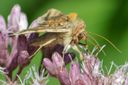
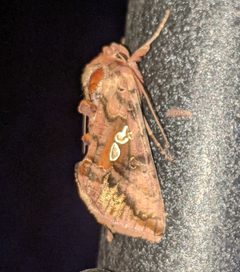
Wingspan measures 37–40 mm. Forewings display a mottled pattern with two prominent gold or silvery spots, giving rise to referencing these markings. Hindwings are typically paler. Body is robust with a furry typical of noctuid .
Habitat
Occupies a range of open and semi-open across its broad distribution, from coastal areas to interior plains and montane regions. Associated with areas supporting larval plants including disturbed sites, meadows, and edges of woodlands.
Distribution
Transcontinental in North America: from Newfoundland westward across Canada to near the British Columbia coast, north to Northwest Territories, and south to New Mexico in the western portion of range and Pennsylvania and Long Island in the east. Documented presence in Alberta, Manitoba, Saskatchewan, and Vermont.
Seasonality
active from July to August, with exact timing varying by location. with one per year.
Diet
Larvae feed on Taraxacum (dandelion) and have been observed to accept Plantago (plantain) and Urtica dioica (stinging nettle) in captivity. feeding habits not documented in available sources.
Life Cycle
Complete with one annually. Larval stage feeds on herbaceous plants. presumably occurs in soil or leaf litter, though specific details not documented. synchronized to summer months.
Behavior
exhibit the characteristic looping pattern that gives the group its . activity pattern typical of Noctuidae.
Ecological Role
Larval herbivory contributes to nutrient cycling in herbaceous plant . may serve as and prey for including bats and birds.
Human Relevance
Minor significance as an agricultural pest; larvae may feed on some crop plants though not considered a major economic . Serves as a subject for ecological and lepidopterological study.
Similar Taxa
- Autographa californicaSimilar looping and general appearance, but distinguished by different spot pattern on forewings and more western distribution
- Autographa gammaEuropean with similar ; distinguished by geographic range and subtle wing pattern differences
More Details
Nomenclature
Originally described as Plusia bimaculata by Stephens in 1830; later transferred to Autographa. Multiple reflect the distinctive paired wing spots.
Sources and further reading
- BugGuide
- Wikipedia
- GBIF taxonomy match
- iNaturalist taxon
- NCBI Taxonomy
- Catalogue of Life
- Do Moths Usually Land with Their Wings Down? | Bug Squad
- In the Loop--on the Mustard | Bug Squad
- Bug Squad
- Bug Eric: Fly Day Friday: Biting Midges, No-See-Ums, Punkies
- Insect Migration (Part 1) - Buglife Blog - Buglife
- An Introduction to the Wonderful World of Wasps: Meet the Heath Sand Wasp - Buglife Blog - Buglife