
Anagrapha falcifera
(Kirby, 1837)
Celery Looper, Celery Looper Moth
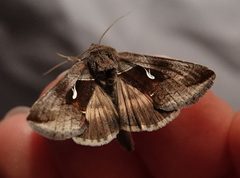
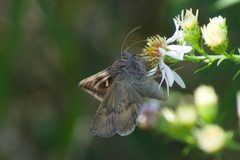
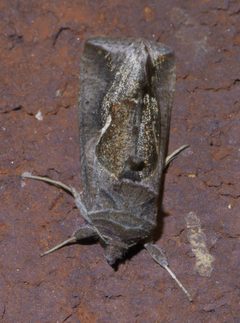
Anagrapha falcifera, the celery looper, is a noctuid native to North America. The was first described by William Kirby in 1837. have a wingspan of 35–40 mm. Larvae are feeders on low-growing plants including agricultural crops. The species gained scientific significance in 1985 when specimens collected in Missouri were found infected with a naturally occurring , which became the first patented baculovirus and contributed to the development of biological insect control products.
Pronunciation
How to pronounce Anagrapha falcifera: /ænəˈɡræfə fɔlˈsɪfərə/
These audio files are automatically generated. While they are not always 100% accurate, they are a good starting point.
Identification
Distinguished from similar loopers (Plusiinae) by a combination of geographic distribution and plant associations. The specific wing pattern and genitalia characteristics that separate it from such as Anagrapha excelsa are not detailed in available sources. Larvae may be identified by their looping locomotion and association with known host plants including beets, lettuce, and clover.
Images
Appearance
have a wingspan of 35–40 mm. As a member of the Plusiinae, it likely exhibits the characteristic looper body plan with relatively broad, somewhat triangular forewings and a more slender . Specific coloration and wing pattern details are not provided in available sources.
Habitat
Associated with agricultural and semi-natural environments where plants occur. Found in areas supporting beets, lettuce, corn, clover, blueberries, and other low-growing vegetation. Specific microhabitat preferences for (e.g., resting sites, nectar sources) are not documented.
Distribution
North America: Newfoundland, Labrador, and southern Canada (Alberta, Manitoba, Saskatchewan confirmed) south to Georgia, Mississippi, Texas, Arizona, Idaho, Washington, and Oregon. GBIF records also indicate presence in Oceania, though this may represent introduced or data artifacts.
Seasonality
activity period not specified in available sources. As a temperate North American , likely active during warmer months, with possible multiple per year given its broad latitudinal range.
Diet
Larvae feed on beets, blueberries, clover, corn, lettuce, plantain, viburnum, and other low plants. feeding habits (nectar sources, if any) are not documented.
Host Associations
- Beta vulgaris - larval food plantbeets
- Vaccinium - larval food plantblueberries
- Trifolium - larval food plantclover
- Zea mays - larval food plantcorn
- Lactuca sativa - larval food plantlettuce
- Plantago - larval food plantplantain
- Viburnum - larval food plant
Life Cycle
Complete with , larva, pupa, and stages. Specific details on number of , stage, or developmental duration are not provided in available sources.
Behavior
Larvae exhibit characteristic looping locomotion due to reduced number of (typical of Plusiinae). No other specific behavioral observations are documented.
Ecological Role
Larval herbivore; serves as for viral including a naturally occurring that has been developed for applications. May function as prey for and , though specific records are not provided.
Human Relevance
Minor agricultural pest on vegetable crops. Scientifically significant as the source of the first patented , discovered in 1985 from infected specimens collected in Missouri by entomologist Ben Puttler. This discovery contributed to the development of viral and products now deployed internationally, including in Africa against fall armyworm.
Similar Taxa
- Anagrapha excelsaCongeneric with potentially overlapping range; specific distinguishing characters not detailed in sources but likely separable by wing pattern and genitalia
- Other Plusiinae (e.g., Trichoplusia ni, Chrysodeixis includens)Similar looper and larval habits; distinguished by wing pattern, size, and geographic distribution
More Details
Historical significance in biological control
In 1985, Ben Puttler collected two A. falcifera larvae that had died from viral . The was identified as a naturally occurring and became the first patented baculovirus. This discovery established a foundation for viral development and exemplifies how routine field collecting can yield major scientific advances.