
Rachiplusia ou
(Guenée, 1852)
Gray Looper Moth
Rachiplusia ou, commonly known as the gray looper , is a of noctuid moth in the Plusiinae. It is widely distributed throughout North and Central America, from the southern and eastern United States through Mexico to Venezuela, Ecuador, and the Dominican Republic. are active from May to October in temperate regions, with year-round activity in southern states. Unlike its South American Rachiplusia nu, which is a major agricultural pest of soybean and sunflower, R. ou has not gained significant status as a crop pest.
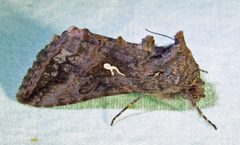
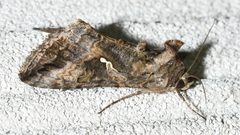
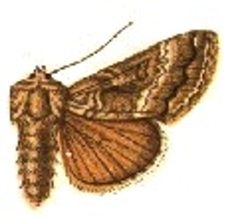
Pronunciation
How to pronounce Rachiplusia ou: /ˌræ.kɪˈpluː.si.ə aʊ/
These audio files are automatically generated. While they are not always 100% accurate, they are a good starting point.
Identification
Larvae can be distinguished from similar plusiine loopers by morphological characters; however, precise field identification requires examination of specific traits such as shape. may be distinguished from related by wing pattern and size, though specific diagnostic features for R. ou versus are not detailed in available sources.
Images
Appearance
have a wingspan of 31–41 mm. As a member of Plusiinae, larvae possess three pairs of and exhibit the characteristic 'looping' locomotion typical of the .
Habitat
Associated with herbaceous vegetation in a variety of open and semi-open across its broad geographic range. Specific microhabitat preferences for larvae and are not well documented.
Distribution
Southern and eastern United States, Montana, Nova Scotia; Mexico; Central and South America including Venezuela, Ecuador, and the Dominican Republic. Also recorded from Manitoba and Saskatchewan in Canada.
Seasonality
are on wing from May to October in temperate regions; year-round activity occurs in southern states of the United States.
Diet
Larvae feed on various herbaceous plants including Chenopodium ambrosioides (epazote), Nicotiana tabacum (tobacco), Trifolium (clover), Mentha (mint), Triticum aestivum (wheat), and Tropaeolum (nasturtium).
Host Associations
- Chenopodium ambrosioides - larval food plantEpazote
- Nicotiana tabacum - larval food plantTobacco
- Trifolium - larval food plantClover
- Mentha - larval food plantMint
- Triticum aestivum - larval food plantWheat
- Tropaeolum - larval food plantNasturtium
Life Cycle
Complete with , larva, pupa, and stages. Specific details on egg deposition sites, location, or time are not documented in available sources.
Behavior
Larvae exhibit 'looping' locomotion characteristic of Plusiinae, moving with a looping gait due to having only three pairs of . are and attracted to light.
Ecological Role
Larval herbivore feeding on diverse herbaceous plants. Not known to be a significant agricultural pest, unlike the Rachiplusia nu which is a major defoliator of soybean and sunflower in South America.
Human Relevance
Minor potential agricultural significance due to larval feeding on crop plants including tobacco, wheat, and clover; however, has not gained status as a major pest. Contrast with Rachiplusia nu, which causes significant economic damage to soybean in Argentina, Brazil, and Uruguay.
Similar Taxa
- Rachiplusia nuCongeneric with similar larval and looping locomotion; distinguished by geographic distribution (primarily South America), darker smoky-blue coloration in older larvae, and status as major soybean and sunflower pest. R. nu larvae have distinct patches of tiny black asperites on thoracic ventors not apparent in similar species.
- Chrysodeixis includensAnother plusiine looper with similar larval appearance; larvae distinguished by bright yellow-green coloration versus darker tones in Rachiplusia , and by shape.
More Details
Taxonomic distinction from R. nu
Rachiplusia ou and R. nu are the two most widely recognized in the . While R. nu has become a major agricultural pest in South American soybean production, R. ou has not achieved comparable pest status in North America despite sharing similar and plant breadth. The reasons for this difference in economic impact are not well understood.
Larval identification challenges
Accurate identification of Rachiplusia larvae in the field is difficult due to similarity with other plusiine loopers. Conclusive identification requires examination of shape, a character not convenient for field use, leading to potential misidentifications where co-occur.
Sources and further reading
- BugGuide
- Wikipedia
- GBIF taxonomy match
- iNaturalist taxon
- NCBI Taxonomy
- Catalogue of Life
- Noctuidae | Beetles In The Bush | Page 3
- armyworms | Beetles In The Bush
- How Beekeepers Can Foster Propolis Production for Better Hive Health
- Platystomatidae | Beetles In The Bush
- Bug Eric: Scientific Illustration
- From the mailbag: Fig-eating Kudzu bugs come to college, Megacopta cribraria — Bug of the Week