
Rachiplusia
Hampson, 1913
sunflower looper (R. nu)
Species Guides
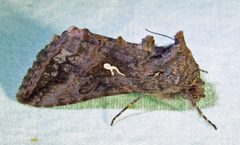
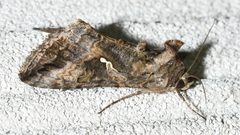
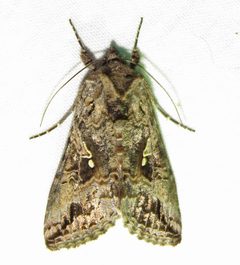
1- Rachiplusia ou(Gray Looper Moth)
Rachiplusia is a of in the Noctuidae, Plusiinae, containing at least four distributed across the Americas. The most economically significant species is Rachiplusia nu, known as the sunflower looper or "oruga medidora del girasol," which has emerged as a major pest of soybean and sunflower in South America. Larvae of this genus are characterized by the looping locomotion typical of Plusiinae, resulting from having only three pairs of . The genus was revised taxonomically by Barbut in 2008, clarifying species boundaries and distributions.
Pronunciation
How to pronounce Rachiplusia: /ˌræ.kɪˈpluː.ziə/
These audio files are automatically generated. While they are not always 100% accurate, they are a good starting point.
Identification
Members of Rachiplusia are distinguished from other Plusiinae by genitalic characters established through taxonomic revision. Larvae of R. nu can be separated from the similar Chrysodeixis includens (soybean looper) by shape, though this requires microscopic examination. Field identification of R. nu larvae relies on coloration: older larvae exhibit a darker, smoky-blue cast compared to the bright yellow-green of C. includens, and possess distinct patches of tiny black asperites on the thoracic venters not apparent in the latter .
Images
Habitat
Agricultural landscapes, particularly soybean and sunflower fields. Dry conditions favor increases, while moist conditions promote pathogenic fungi that suppress larval populations. Early season populations often establish in alfalfa and flax before moving to soybean and sunflower.
Distribution
South America (Argentina, Bolivia, Brazil, Chile, Paraguay, Peru, Uruguay) for R. nu; North and Central America for R. ou. R. nu is the most widely distributed South American in the .
Seasonality
in soybean tend to occur during reproductive stages of plant growth. Activity patterns align with crop , with early season establishment in alternate followed by movement to soybean and sunflower.
Diet
R. nu larvae feed on soybean (Glycine max), sunflower, alfalfa, and flax. Young larvae consume only the lower between leaf , creating "window paning" damage. Older larvae consume entire tissue layers while avoiding vascular tissue, resulting in skeletonized foliage. A single larva can consume more than 100 cm² of soybean foliage.
Host Associations
- Glycine max - food plantprimary , soybean
- Helianthus annuus - food plantsunflower, heavily attacked in drier western regions
- Medicago sativa - food plantalfalfa, early season
- Linum usitatissimum - food plantflax, early season
Life Cycle
Complete : , larva, pupa, . Eggs are laid primarily on undersides of leaves. larvae begin feeding on lower leaf surfaces. Larvae pass through multiple instars, with older larvae causing the most significant damage. occurs in soil or leaf litter. Multiple per year are possible in favorable conditions.
Behavior
Larvae exhibit characteristic looping locomotion due to reduced number (three pairs), typical of Plusiinae. Young larvae feed gregariously or in close proximity to mass sites before dispersing as they grow. are and have been observed hovering at flowers during dusk without landing.
Ecological Role
Herbivore and agricultural pest. Historically a secondary pest of soybean, R. nu has become a primary pest due to evolution of resistance to Cry1Ac Bt toxin. Larvae serve as for pathogenic fungi that regulate under moist conditions. The is a target for using such as Autographa californica multiple (AcMNPV), registered in Brazil in 2023.
Human Relevance
Significant economic pest of soybean and sunflower in South America, particularly Argentina and Brazil. Yield losses occur when defoliation exceeds approximately 15% during reproductive plant stages. Management is complicated by differing susceptibilities between R. nu and the co-occurring Chrysodeixis includens, leading to control failures and increased pesticide applications when misidentification occurs. Resistance to Cry1Ac Bt toxin has been documented in Brazilian . Subject of resistance monitoring using diagnostic concentrations of AcMNPV.
Similar Taxa
- Chrysodeixis includensLarvae nearly identical in appearance and share soybean as ; distinguished by shape, larval coloration (bright yellow-green vs. smoky-blue in older R. nu), and thoracic asperites; differs in susceptibility and geographic distribution
- Pseudoplusia includensFormer name for C. includens; taxonomic synonymy now resolved under Chrysodeixis
- Anticarsia gemmatalisCo-occurring noctuid defoliator of soybean in South America; distinguished by larval and —A. gemmatalis has four pairs of and does not exhibit looping locomotion
- Spodoptera spp. co-occurring in soybean; distinguished by larval including number and arrangement of , pinaculae, and capsule markings
More Details
Taxonomic revision
Barbut (2008) revised the , clarifying that R. ou is restricted to North and Central America while R. nu occurs in South America, correcting earlier confusion in the literature.
Resistance evolution
Brazilian of R. nu have evolved practical resistance to Cry1Ac Bt toxin, elevating its pest status from secondary to primary. No has been detected between this Bt resistance and susceptibility to AcMNPV .
Diagnostic tools
A diagnostic concentration of 1.6×10⁹ occlusion bodies/mL (₉₉) of AcMNPV has been established for resistance monitoring in Brazilian , causing >97% mortality in susceptible field populations.
Sources and further reading
- BugGuide
- Wikipedia
- GBIF taxonomy match
- iNaturalist taxon
- NCBI Taxonomy
- Catalogue of Life
- Noctuidae | Beetles In The Bush | Page 3
- armyworms | Beetles In The Bush
- Baseline Susceptibility and Diagnostic Concentration of AcMNPV in Rachiplusia nu (Lepidoptera: Noctuidae) in Brazil and Cross-resistance to Cry1Ac.