
Aseptis characta
Grote, 1880
Aseptis characta is a noctuid widespread across western North America, ranging from British Columbia to southern California. are active from April through August depending on elevation and latitude, with earlier in drier . The species inhabits arid environments including sagebrush steppe and juniper woodlands from sea level to 2,500 meters elevation.
Pronunciation
How to pronounce Aseptis characta: /əˈsɛptɪs kəˈræk.tə/
These audio files are automatically generated. While they are not always 100% accurate, they are a good starting point.
Identification
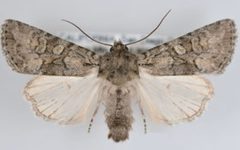
Distinguished from similar Aseptis by the combination of ash gray to pale tan forewings with variable olive-gray, tan, or orange-tan patches, and the pattern of double dark gray lines with pale gray fill. The black wedges between in the postmedial area and the three black-outlined spots are diagnostic features. The relatively pale hindwing (gray to white) with dark discal spot and terminal line separates it from darker-winged .
Images
Appearance
Wingspan 29.5–35 mm. Forewings ash gray to pale tan, often darker gray in medial area with variable olive-gray, tan, or orange-tan patches. Basal, antemedial and postmedial lines double, dark gray filled with pale gray. Postmedial area lighter with shade preceding pale subterminal line; black wedges present between . Three spots outlined in black, filled with ground color and peripheral lighter gray (except claviform spot). Hindwing gray, pale gray, or white with dark discal spot, veins, and terminal line; darker in females.
Habitat
Dry including sagebrush steppe, juniper woodlands, and open forest. Found from sea level to 2,500 meters elevation. Xeric conditions favor earlier .
Distribution
Western North America: western Great Plains, Great Basin, and Pacific regions. Recorded from British Columbia, Alberta, Saskatchewan, Colorado, Utah, northern Arizona, and southern California.
Seasonality
emerge earliest in xeric , typically April in California and mid-May in the Pacific Northwest. period extends until July to August depending on locality.
Diet
Larvae feed on Artemisia .
Host Associations
- Artemisia - larval food plant of sagebrush and related plants
Similar Taxa
More Details
Original description
First described by Augustus Radcliffe Grote in 1880 under the basionym Hadena characta.
Elevation range
Occurs from sea level to 2,500 meters, with varying by elevation and aridity.