
Spodoptera albula
Walker, 1857
Gray-streaked Armyworm Moth, Unbarred Spodoptera Moth, Gray-streaked Armyworm
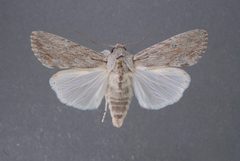
Spodoptera albula is a noctuid distributed from the southern United States through South America. The has a wingspan of 33–35 mm. Larvae are but show a preference for Amaranthus , and have been documented as a minor pest of soybean in Brazil. The species is one of several Spodoptera armyworms affecting agricultural crops in the Americas, though it remains less economically significant than such as S. eridania or S. cosmioides.
Pronunciation
How to pronounce Spodoptera albula: /spɔˈdɔp.tɛ.ra ˈal.bu.la/
These audio files are automatically generated. While they are not always 100% accurate, they are a good starting point.
Identification
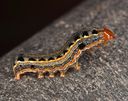
Larvae distinguished from other South American Spodoptera by combination of: trapezoidal (not semicircular) mesothoracic marking; relative size progression of abdominal segment markings (first and sixth smaller than seventh and eighth); absence of orange in dorsolateral stripe; white-spotted triangular abdominal markings. Differs from S. cosmioides (black ) in mesothoracic marking shape and dorsolateral stripe coloration. Differs from S. eridania (southern armyworm) in abdominal marking pattern and stripe characteristics.
Images
Habitat
Agricultural and weedy . Larvae associated with Amaranthus . Documented in soybean fields in Brazil, though not a primary pest of this crop. Occurs in Chaco Province, Argentina, and southern United States.
Distribution
Southern United States south through Mexico, Central America, and South America. Documented in Brazil (multiple states: AC, AL, DF, ES, MG, PA, PB, PE, PR, RS), Argentina (Chaco Province, Buenos Aires Province), and extreme southern U.S.
Diet
Larvae feed on Amaranthus (Amaranthaceae). but shows preference for amaranth. Documented as feeding on soybean foliage in Brazil, though with less economic impact than other Spodoptera species.
Host Associations
- Amaranthus - food plantPreferred ; larvae feed on multiple Amaranthus
- Glycine max - occasional food plantSoybean; larvae feed on foliage but economic impact minor compared to
Life Cycle
Complete with , larva, pupa, and stages. Specific details of duration and not documented in available sources. Larvae are the damaging stage.
Ecological Role
Herbivore in agricultural and natural . Larval feeding on Amaranthus may contribute to weed . Minor pest status in soybean agroecosystems.
Human Relevance
Minor agricultural pest. Cited as pest of soybean in Brazil, though importance has not matched that of S. eridania (southern ) or S. cosmioides (black armyworm). Larval feeding on soybean foliage can reduce photosynthetic capacity; direct pod damage not emphasized in literature. Control typically through applications targeting lepidopteran pest complexes.
Similar Taxa
- Spodoptera cosmioidesBoth occur on soybean in South America; S. cosmioides has semicircular to slightly trapezoidal mesothoracic marking (vs. distinctly trapezoidal in S. albula) and white-orange dorsolateral stripe (vs. white-only in S. albula)
- Spodoptera eridaniaBoth widespread in South America and feed on soybean; S. eridania typically has larger black spots on first abdominal segment than sixth, and different dorsolateral stripe characteristics
- Spodoptera frugiperdaBoth in same region; S. frugiperda distinguished by pinaculae with single stout seta on dorsum, square arrangement on eighth abdominal segment, and inverted white Y-shaped marking
- Spodoptera exiguaBoth noctuids; S. exigua typically green above with pinkish or yellowish below, white lateral stripe, and dark spot on when present
- Spodoptera ornithogalliBoth North and South American armyworms; S. ornithogalli has paired black triangular spots with yellow stripes not interrupted by spots, often black velvety appearance
More Details
Taxonomic history
Described by Walker in 1857. No major taxonomic revisions or synonymy issues noted in recent literature.
Economic significance context
Among six Spodoptera encountered in soybean by agricultural entomologist Ted C. MacRae during field work in U.S. and South America, S. albula was the least economically significant. Its preference for Amaranthus may reduce competitive interaction with soybean-specializing .
Identification challenges
larvae identification difficult due to similarity of appearance, lack of distinctive morphological differences, and intraspecific color variability. Conclusive identification of S. albula requires examination of large larvae with attention to subtle thoracic and abdominal segment markings.
Sources and further reading
- BugGuide
- Wikipedia
- GBIF taxonomy match
- iNaturalist taxon
- NCBI Taxonomy
- Catalogue of Life
- Quick Guide to Armyworms on Soybean | Beetles In The Bush
- October | 2013 | Beetles In The Bush
- Noctuidae | Beetles In The Bush | Page 2
- Lepidoptera | Beetles In The Bush | Page 6
- Argentina | Beetles In The Bush | Page 2
- economic pests | Beetles In The Bush