
Euxoa violaris
Grote & Robinson, 1868
Violet Dart, violet dart moth
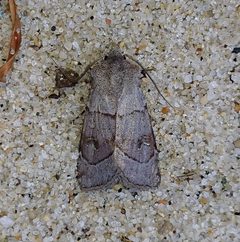
Euxoa violaris, the violet dart , is a of noctuid moth native to North America. Described in 1868 by Grote and Robinson, it is listed as a species of special concern in Connecticut. As a member of the Euxoa, its larvae likely share characteristics with other cutworms in the genus, though species-specific remains poorly documented.
Pronunciation
How to pronounce Euxoa violaris: /juːkˈsoʊ.ə vaɪˈoʊ.lərɪs/
These audio files are automatically generated. While they are not always 100% accurate, they are a good starting point.
Identification
The "violet dart" suggests violet or purple coloration in the , distinguishing it from other Euxoa which typically exhibit dull brown or gray tones. Noctuid moths in this generally have stout bodies and relatively broad forewings. Positive identification requires examination of genitalia or reference to original species description.
Images
Distribution
Native to North America. Specific range details beyond this continental distribution are not documented in available sources.
Human Relevance
Listed as a of special concern in Connecticut, indicating conservation interest at the state level. No documented agricultural or economic significance.
Similar Taxa
- Euxoa auxiliarisBoth share the Euxoa and pattern (X dart), but E. auxiliaris is known as the with well-documented larval pest , whereas E. violaris lacks such documentation
- Euxoa mimallonisAnother Euxoa with a color-based (Ruddy-winged Dart), suggesting similar naming conventions for related species with distinct wing coloration
More Details
Conservation Status
The of special concern listing in Connecticut suggests localized concerns, though the specific threats or population trends are not detailed in available sources.
Taxonomic History
Original description by Augustus Radcliffe Grote and Coleman Townsend Robinson in 1868 places this among early-described North American noctuids, yet modern biological study appears limited.
Sources and further reading
- BugGuide
- Wikipedia
- GBIF taxonomy match
- iNaturalist taxon
- NCBI Taxonomy
- Catalogue of Life
- Aboveground Pests - AgriLife Extension Entomology
- Stem- and Leaf- Feeding Insects - AgriLife Extension Entomology
- Bug Eric: Winter 'pillars
- How Army Cutworm Moths Bounce Between Midwest Heat and Alpine Cool
- Bug Eric: My Kind of Fourth of July
- Bug Eric: July 2019