
Euxoa medialis
Smith, 1888
median-banded dart
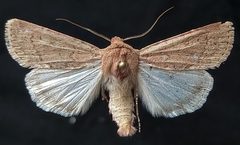
Euxoa medialis, the -banded dart, is a noctuid first described by Smith in 1888. It occurs across western North America from southern Manitoba to south-central Mexico. have a wingspan of approximately 40 mm and are active in September in Alberta. The belongs to the cutworm moth Euxoa, whose larvae are agricultural pests.
Pronunciation
How to pronounce Euxoa medialis: /juːkˈsoʊ.ə miːˈdiːəlɪs/
These audio files are automatically generated. While they are not always 100% accurate, they are a good starting point.
Identification
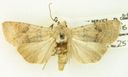
can be distinguished from similar Euxoa by the banding pattern on the forewings, as referenced in the . The species is smaller than some related cutworm moths, with a wingspan of approximately 40 mm. Accurate identification typically requires examination of genitalia or reference to regional Euxoa identification keys. Similar species include other Euxoa dart moths, which may require dissection or molecular methods for definitive separation.
Images
Appearance
have a wingspan of about 40 mm. As a member of the Euxoa, adults likely exhibit the typical drab brownish-gray coloration common to dart moths, with forewings showing characteristic banded or streaked patterns that provide camouflage against soil and vegetation.
Habitat
Found in diverse terrestrial across its range, including grasslands, agricultural fields, and open woodlands. As with other Euxoa , larvae likely inhabit soil and ground-level vegetation.
Distribution
North America from southern Manitoba and central Wisconsin west to southwest Alberta and California; north to southern Alberta and south to south-central Mexico. Distribution records include Alberta, Manitoba, and Saskatchewan in Canada.
Seasonality
are on wing in September in Alberta. likely varies across the broad latitudinal range, with earlier periods in southern portions of the range.
Life Cycle
Complete with , larva, pupa, and stages. As a member of the Euxoa, larvae likely overwinter and feed on plant stems at or below soil level. Specific details for this are not documented.
Behavior
are and attracted to light. As with other Euxoa , larvae are likely nocturnal feeders that hide in soil during daylight hours.
Ecological Role
Larvae likely function as herbivores in soil . may serve as prey for including bats and birds.
Human Relevance
As a member of the Euxoa, larvae may potentially damage agricultural crops by cutting stems of seedlings, though specific economic impact of this is not documented. The genus includes several significant agricultural pests.
Similar Taxa
- Euxoa auxiliarisSimilar size and appearance as a congeneric dart moth; distinguished by different wing pattern and distribution overlapping in parts of western North America
- Other Euxoa speciesMany Euxoa are morphologically similar and require genitalia examination or molecular analysis for definitive identification
More Details
Taxonomic history
First described by Smith in 1888. The epithet 'medialis' refers to the banding pattern on the forewings.
Collection records
Documented in the E.H. Strickland Entomological Museum at the University of Alberta.
Sources and further reading
- BugGuide
- Wikipedia
- GBIF taxonomy match
- iNaturalist taxon
- NCBI Taxonomy
- Catalogue of Life
- Aboveground Pests - AgriLife Extension Entomology
- Stem- and Leaf- Feeding Insects - AgriLife Extension Entomology
- Bug Eric: Winter 'pillars
- How Army Cutworm Moths Bounce Between Midwest Heat and Alpine Cool
- Bug Eric: My Kind of Fourth of July
- Bug Eric: July 2019