
Euxoa comosa
Morrison, 1876
hairy euxoa moth
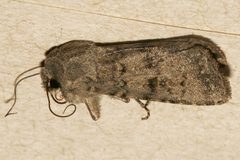
Euxoa comosa is a noctuid native to northern North America, commonly known as the hairy euxoa moth. The exhibits considerable geographic variation, with five recognized distributed across western North America eastward through the northern Great Plains to the Atlantic Ocean. have a wingspan of approximately 32 mm. Larvae are cutworms that have been recorded feeding on Secale cereale (rye) and are likely feeders on various plants.
Pronunciation
How to pronounce Euxoa comosa: //juːkˈsoʊə koʊˈmoʊsə//
These audio files are automatically generated. While they are not always 100% accurate, they are a good starting point.
Identification
Distinguished from similar Euxoa by genital characters that define the comosa group. The five (comosa, altera, annir, lutulenta, ontario) are primarily separated by geographic distribution and subtle morphological differences. Subspecies identification requires examination of genitalia and geographic origin. The comosa group includes six species: comosa, lineifrons, guadalupensis, lucida, fumalis, and occidentalis, all sharing characteristic genital structures.
Images
Appearance
have a wingspan of approximately 32 mm. The shows geographic variation in adult across its range, with distinguished by adult characteristics. stages are morphologically similar across subspecies, though subspecies lutulenta has 40-50% larger than other subspecies, and larvae of lutulenta and ontario are darker than those of annir and altera.
Distribution
Western North America, except the Pacific coast, ranging east through the northern Great Plains, and in the Hudsonian zone to the Atlantic Ocean. Found in every province and territory of Canada except Nunavut. have more restricted ranges: altera in Manitoba and North Dakota; annir in Colorado, North Dakota, and Alberta; lutulenta in California, Alberta, British Columbia, and Oregon; ontario in Ontario and New Brunswick.
Diet
Larvae have been recorded feeding on Secale cereale (rye). As a , larvae are likely feeders, though specific records beyond rye are not documented in available sources.
Life Cycle
show differentiation in larval growth rate, number of larval instars, duration of preimaginal development, and length of preoviposition period. Complete with , larva, pupa, and stages. Larval stage is the form.
Behavior
are . Females exhibit calling with periods of release; calling periods of largely overlap though differences in initiation time may contribute to mating . Subspecies show moderate levels of mating discrimination in experimental conditions.
Human Relevance
Similar Taxa
- Euxoa auxiliarisBoth are Euxoa cutworms with similar larval habits, but E. auxiliaris () is distinguished by its distinctive mass and alpine not reported in E. comosa; E. comosa has a more northern and eastern distribution
- Euxoa lineifronsMember of the same comosa group, distinguished by genital characters; E. lineifrons has different geographic distribution and
- Euxoa messoriaSimilar in the same ; requires genital examination for definitive separation, though E. comosa belongs to the distinct comosa group defined by specific genital characters
Sources and further reading
- BugGuide
- Wikipedia
- GBIF taxonomy match
- iNaturalist taxon
- NCBI Taxonomy
- Catalogue of Life
- Aboveground Pests - AgriLife Extension Entomology
- Stem- and Leaf- Feeding Insects - AgriLife Extension Entomology
- Bug Eric: Winter 'pillars
- How Army Cutworm Moths Bounce Between Midwest Heat and Alpine Cool
- Bug Eric: My Kind of Fourth of July
- Bug Eric: July 2019
- BIOSYSTEMATICS OF THE GENUSEUXOA(LEPIDOPTERA: NOCTUIDAE): XVI. COMPARATIVE BIOLOGY AND EXPERIMENTAL TAXONOMY OF FOUR SUBSPECIES OFEUXOA COMOSA
- A REVISION OF THE COMOSA GROUP OF THE GENUS EUXOA HBN. (LEPIDOPTERA: NOCTUIDAE), WITH DESCRIPTIONS OF TWO NEW SPECIES