
Copablepharon fuscum
Troubridge & Crabo, 1996
sand-verbena moth
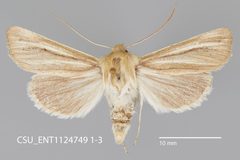
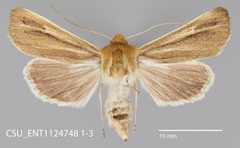
Copablepharon fuscum, commonly known as the sand-verbena , is a noctuid moth restricted to sandy ocean beaches along the Pacific coast of North America. The species was described in 1996 by Troubridge and Crabo. have a wingspan of 35–40 mm. The larvae are specialized feeders on Abronia latifolia (yellow sand-verbena), a coastal dune plant. The species has a very limited geographic range and is considered at risk due to loss and degradation of coastal dune .
Pronunciation
How to pronounce Copablepharon fuscum: /koʊpˌæbləˈfærən ˈfʌskəm/
These audio files are automatically generated. While they are not always 100% accurate, they are a good starting point.
Identification
A medium-sized noctuid with wingspan 35–40 mm. Distinguished from related by its restriction to sandy coastal beach and association with Abronia latifolia plants. The species was originally described from specimens collected in British Columbia and Washington.
Images
Habitat
Sandy ocean beaches, specifically coastal dune systems. The is characterized by loose, shifting sands and sparse vegetation dominated by sand-verbena and other dune-adapted plants.
Distribution
Restricted to the Pacific coast of North America. Known from sandy beaches in British Columbia, Canada and Washington State, USA. The distribution is highly localized and discontinuous, limited to suitable coastal dune .
Diet
Larvae feed exclusively on Abronia latifolia (yellow sand-verbena), a succulent plant of coastal dunes.
Host Associations
- Abronia latifolia - larval food plantyellow sand-verbena; exclusive
Human Relevance
Subject to conservation concern due to loss from coastal development, recreational beach use, and . A recovery strategy has been developed for the in British Columbia. The narrow habitat specificity and limited range make it vulnerable to local extinction.
Similar Taxa
- Copablepharon longipenneCongeneric in the same ; distinguished by geographic range and subtle morphological differences in wing venation and male genitalia.
- Other Noctuinae coastal mothsSimilar size and general appearance; distinguished by specificity (sand-verbena is restricted to active dune systems with Abronia) and larval association.