
Copablepharon longipenne
Grote, 1882
Dusky Dune Moth
Copablepharon longipenne is a noctuid native to the Great Plains and southwestern North America. It inhabits sand dune where larvae live and feed underground near plants. The has a single , with active in mid-summer. Two are recognized: the nominate form and C. l. serraticornis.
Pronunciation
How to pronounce Copablepharon longipenne: /koʊˌpæbləˈfɛrɒn ˌlɒnˈdʒɪpɛnˌeɪ/
These audio files are automatically generated. While they are not always 100% accurate, they are a good starting point.
Identification
The can be distinguished from other Copablepharon species by geographic range and association with sand dune . The C. l. serraticornis differs in antennal serration. Accurate identification may require examination of genitalia or reference to .
Images
Appearance
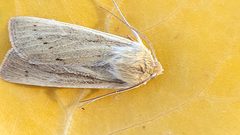
have a wingspan of 35–39 mm. The exhibits the typical noctuid body plan with scaled wings.
Habitat
Sand dune . Larvae occur in soil approximately 2.5 cm deep near plants.
Distribution
North American Great Plains and southwestern regions: southwestern Manitoba to southern Alberta, south to western Texas. Canadian provincial records include Alberta, Manitoba, and Saskatchewan.
Seasonality
are active from July to August, with exact timing varying by location. One per year.
Life Cycle
Complete with one annually. are laid near plants. Larvae live buried approximately 2.5 cm deep in soil and feed underground. occurs in soil, with emerging approximately 2.5 weeks later.
Behavior
Larvae exhibit subterranean feeding , remaining buried in soil while consuming plant material. are .
Ecological Role
Herbivore in sand dune . Larval underground feeding may contribute to soil aeration and nutrient cycling in dune .
Similar Taxa
- Other Copablepharon speciesShare and general ; distinguished by geographic distribution, specificity, and detailed morphological examination
- Other Noctuinae in sand dune habitatsMay co-occur in similar ; C. longipenne distinguished by association with deep-burrowing larval and specific geographic range
More Details
Subspecies
Two recognized: Copablepharon longipenne longipenne Grote, 1882 (nominate form) and Copablepharon longipenne serraticornis A. Blanchard, 1976. The latter is distinguished by serrate male .
Conservation status
Sand dune are vulnerable to degradation from development, agriculture, and ; specific trends for this are not documented.