
Agrotis volubilis
Harvey, 1874
Voluble Dart, Voluble Dart Moth
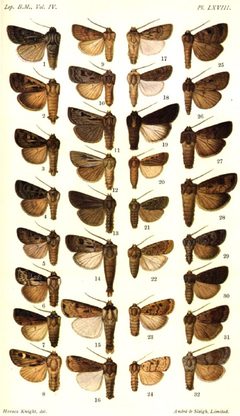
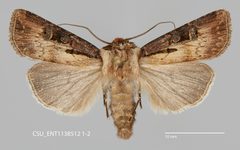
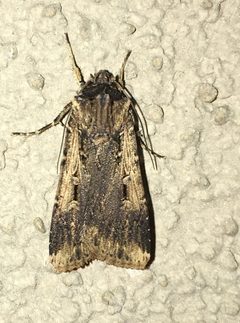
Agrotis volubilis, the voluble dart , is a noctuid moth described by Leon F. Harvey in 1874. It has a broad distribution across North America, ranging from Newfoundland to British Columbia in Canada and from Maine to Florida west to the Pacific Coast in the United States. The species is , with active from May to July. Larvae are feeders on a variety of herbaceous plants including agricultural crops.
Pronunciation
How to pronounce Agrotis volubilis: /əˈɡroʊtɪs voʊˈljuːbɪlɪs/
These audio files are automatically generated. While they are not always 100% accurate, they are a good starting point.
Identification
can be distinguished from similar Agrotis by genitalia examination; external is generally cryptic and requires expert identification. The voluble dart is part of a large of cutworm moths, many of which are difficult to separate without dissection. Larvae are identified by association with adult specimens or by rearing; they are not readily distinguishable from other Agrotis larvae based on external features alone.
Images
Habitat
Found in a variety of open including agricultural fields, grasslands, and disturbed areas. Larval habitat includes soil surface and root zone of plants. are attracted to light.
Distribution
North America: Canada (Newfoundland to British Columbia, including Alberta, Manitoba, Saskatchewan); United States (Maine to Florida, west to the West Coast).
Seasonality
active from May to July. One per year (). Larvae present in spring and early summer, pupating in soil.
Diet
Larvae are , feeding on a wide range of herbaceous plants including Medicago sativa (alfalfa), Phaseolus (beans), Cerastium (mouse-ear chickweed), Trifolium (clover), Zea mays (corn), Hordeum pusillum (little barley), and Nicotiana (tobacco).
Host Associations
- Medicago sativa - larval food plantalfalfa
- Phaseolus - larval food plantbeans
- Cerastium - larval food plantmouse-ear chickweed
- Trifolium - larval food plantclover
- Zea mays - larval food plantcorn
- Hordeum pusillum - larval food plantlittle barley
- Nicotiana - larval food planttobacco
Life Cycle
One per year. laid in soil or on plant stems and leaves. Larvae hatch in 2–14 days and feed on plants. Larvae overwinter as small larvae in in clumps of grass or in soil under debris. occurs in soil in early summer. emerge May–July.
Behavior
Larvae are , feeding at night and remaining hidden in soil during the day. When disturbed, larvae curl into a C-shape. are nocturnal and attracted to light. prefer to lay in grassy and weedy fields.
Ecological Role
Larvae function as herbivores and agricultural pests, acting as cutworms that sever plant stems at or below the soil surface. As feeders, they contribute to nutrient cycling through herbivory. serve as prey for including bats and birds.
Human Relevance
Agricultural pest. Larvae damage crops by cutting stems at, slightly below, or above the soil surface, potentially reducing plant stands. Affected crops include corn, beans, alfalfa, clover, and tobacco. Managed through cultural practices (weed control, seedbed preparation) and applications when exceed .
Similar Taxa
- Agrotis ipsilon (black cutworm)Similar larval and feeding ; distinguished by genitalia and geographic/temporal distribution patterns.
- Agrotis orthogonia (pale western cutworm)Similar subterranean habit; A. orthogonia prefers loose, sandy, dry soils and is more restricted to western North America.
- Euxoa speciesOther with similar larval habits and ; require genitalia dissection or molecular methods for reliable separation.
More Details
Subspecies
Two recognized: Agrotis volubilis volubilis and Agrotis volubilis fumipennis.
Type material
described by Leon F. Harvey in 1874.
Sources and further reading
- BugGuide
- Wikipedia
- GBIF taxonomy match
- iNaturalist taxon
- NCBI Taxonomy
- Catalogue of Life
- Congrats to Antoine Abrieux, Innovator Fellow Award | Bug Squad
- Occasional Pests - AgriLife Extension Entomology
- Encyrtid Holdings | Entomology Research Museum
- Stem- and Leaf- Feeding Insects - AgriLife Extension Entomology
- Antoine Brieux to Share PPTM Research on Fruit Fly | Bug Squad
- Insect-resistant Maize Could Increase Yields and Decrease Pesticide Use in Mexico