
Agrotis orthogonia
Morrison, 1876
Pale Western Cutworm Moth, Pale Western Cutworm
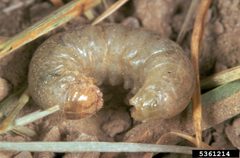
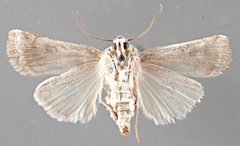
Agrotis orthogonia, the , is a noctuid moth native to dry regions of western North America. Its larvae are subterranean cutworms that feed on the stems of wheat and other small grains just below the soil surface, causing significant agricultural damage during . The prefers loose, sandy, dry, or dusty soils and is particularly associated with wheat production systems. moths emerge in late summer and fall, with most hatching in late winter or early spring.
Pronunciation
How to pronounce Agrotis orthogonia: /əˈɡroʊtɪs ɔrˈθoʊɡoʊniə/
These audio files are automatically generated. While they are not always 100% accurate, they are a good starting point.
Identification
Distinguished from other Agrotis cutworms by its subterranean feeding habit and association with dry, sandy soils of western North America. Larvae feed specifically on crown stems below the soil surface rather than cutting plants at or above the surface. The can be separated from the black cutworm (Agrotis ipsilon) and other congeneric by geographic range (western drylands vs. broader distribution) and preference. may require dissection or molecular methods for definitive identification from related species.
Images
Habitat
Dry, semi-desert areas of western North America. Prefers loose, sandy, dry, or dusty soils. Associated with agricultural fields, particularly wheat, and weedy or grassy areas that serve as oviposition sites. The thrives in arid and semi-arid environments with well-drained soils.
Distribution
Western North America from southern Canada (Alberta, Saskatchewan, Manitoba) southward to California, ranging eastward nearly to the eastern edge of the Great Plains. Present in the Canadian prairies and the western United States.
Seasonality
emerge and are active in late summer and fall (August–October), when mating and oviposition occur. hatch primarily in late winter or early spring, with larval development proceeding through spring. Larvae pupate in soil in early summer, with the pre-pupal stage over-summering until August .
Diet
Larvae feed subterraneously on stems of wheat and other small grains, specifically targeting the crown region just below the soil surface. They may also feed on other grass . likely feed on nectar or other liquid sources, though specific adult diet is not documented.
Host Associations
- Triticum aestivum - larval food plantprimary agricultural
- small grains - larval food plantgeneral category including barley, oats, rye
- grasses - larval food plantwild grass for oviposition and early feeding
Life Cycle
Females deposit up to 300 per individual in cultivated soil during late summer and fall. Some eggs may hatch in fall, but most overwinter and hatch in late winter or early spring. Larvae develop through spring, feeding subterraneously on plant stems. Mature larvae burrow into soil to form pre-pupal in early summer, over-summering in this stage. occurs in August, with emerging shortly thereafter. There is one per year.
Behavior
Larvae are feeders that remain underground during daylight hours. They exhibit typical of curling into a C-shape when disturbed. The subterranean feeding habit distinguishes this from surface-feeding cutworms. are nocturnal and attracted to light. can develop rapidly under favorable dry conditions, with larvae capable of destroying fields in days during severe .
Ecological Role
As a primary consumer, larvae transfer energy from plants to higher . The serves as prey for including birds, ground beetles, and . can significantly alter plant structure in agricultural systems. The species is considered a pest in agroecosystems but likely functions as a natural herbivore in native grassland .
Human Relevance
Major agricultural pest of wheat and small grains in western North America. Economic damage occurs when larvae sever stems below the soil surface, causing wilting, stand thinning, and plant death. are favored by dry spring conditions. Management relies on cultural practices (weed control, seedbed preparation) and applications. Action thresholds suggest treatment at 1 larva per square foot when yield potential is good, or 2 per square foot when yield potential is low. Insecticide and at-planting applications are used preventively.
Similar Taxa
- Agrotis ipsilonBlack cutworm; distinguished by surface-feeding , broader geographic distribution, and darker larval coloration
- Euxoa messoriaDarksided cutworm; differs in larval color pattern and surface-feeding habits
- Agrotis exclamationis and dart moth; European with different larval and geographic range
More Details
Population Dynamics
of A. orthogonia are associated with dry springs that favor larval survival. crashes may follow wet conditions. The demonstrates -dependent typical of eruptive agricultural pests.
Management History
Historically significant pest in Canadian prairie wheat production. Modern emphasizes monitoring, action thresholds, and targeted application rather than prophylactic treatments.
Sources and further reading
- BugGuide
- GBIF taxonomy match
- iNaturalist taxon
- NCBI Taxonomy
- Catalogue of Life
- Occasional Pests - AgriLife Extension Entomology
- Congrats to Antoine Abrieux, Innovator Fellow Award | Bug Squad
- Encyrtid Holdings | Entomology Research Museum
- Stem- and Leaf- Feeding Insects - AgriLife Extension Entomology
- Antoine Brieux to Share PPTM Research on Fruit Fly | Bug Squad
- Insect-resistant Maize Could Increase Yields and Decrease Pesticide Use in Mexico