
Agrotis gladiaria
Morrison, 1874
Swordsman Dart, Claybacked Cutworm
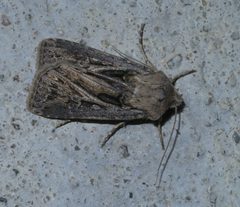
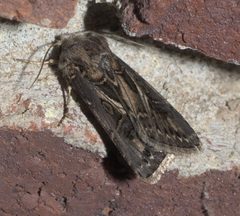
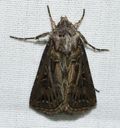
Agrotis gladiaria is a noctuid commonly known as the Swordsman Dart or Claybacked . The is distributed across eastern North America, from southeastern Canada through the eastern United States. are active in autumn, with larvae feeding on a broad range of agricultural and wild plants. The larval stage functions as a cutworm, severing plant stems at or near the soil surface.
Pronunciation
How to pronounce Agrotis gladiaria: /əˈgrəʊtɪs ɡlæˈdaɪəriə/
These audio files are automatically generated. While they are not always 100% accurate, they are a good starting point.
Identification
distinguished from similar Agrotis by forewing pattern and size; precise identification requires examination of genitalia. Forewing length of 13–16 mm separates it from larger . The 'Claybacked' refers to the relatively uniform, earthy coloration. Larvae identified as cutworms by their C-shaped curling and subterranean habits; species-level identification of larvae is difficult and requires rearing to adulthood.
Images
Habitat
Agricultural fields, grasslands, meadows, and open disturbed areas. Larvae occur in soil or under surface debris. attracted to light. Grassy and weedy fields preferred for oviposition.
Distribution
Southeastern Canada (Nova Scotia to Ontario) and eastern United States (Maine to Florida panhandle, west to eastern Texas, eastern Kansas, eastern Nebraska, southern Wisconsin, and Michigan).
Seasonality
active September to October, varying by latitude and local climate. Single brooded (). Larvae present spring through summer, pupating in soil. stage not definitively established for this ; most Agrotis cutworms overwinter as larvae or pupae.
Diet
Larvae , feeding on diverse plants including: Medicago sativa (alfalfa), Asteraceae (sunflower ), Fabaceae (legumes), Rubus (brambles), Poa (bluegrass), Andropogon (bluestem), Brassica oleracea (cabbage), Trifolium (clover), Zea mays (corn), Solidago (goldenrod), Hordeum pusillum (little barley), Avena (oats), Allium (onions), Ipomoea batatas (sweet potato), Nicotiana (tobacco), and Solanum lycopersicum (tomato). do not feed.
Life Cycle
Complete : , larva, pupa, . Eggs laid on soil, stems, or leaves. Larval development spans spring and summer. occurs in soil. Adults emerge in autumn. Specific timing of stage not documented.
Behavior
Larvae , remaining underground or under debris during daylight. Feeding occurs at night. Larvae sever plant stems at, slightly below, or above soil surface—typical '' damage. nocturnal, attracted to artificial light sources.
Ecological Role
Larval herbivore; significant agricultural pest due to stem-cutting . Contributes to nutrient cycling through plant material consumption. Serves as prey for ground-foraging birds, rodents, and predatory insects.
Human Relevance
Agricultural pest of field crops and vegetables. Damage occurs through seedling destruction via stem severing. Management includes cultural practices (weed control, seedbed preparation) and application. Listed among requiring monitoring in sorghum and other grain crops.
Similar Taxa
- Agrotis ipsilon (Black Cutworm)Similar size and general appearance; distinguished by forewing pattern details and genitalia. A. ipsilon has more widespread North American distribution and is more frequently reported as a crop pest.
- Agrotis orthogonia (Pale Western Cutworm)Both are subterranean cutworms, but A. orthogonia is restricted to drier western regions and has paler coloration. A. gladiaria occurs in eastern North America with more mesic climate associations.
- Euxoa spp.Related noctuid cutworms with similar larval habits; distinguished by genitalia and forewing pattern details. Euxoa often have more contrasting forewing markings.
More Details
Taxonomic Note
Authority sometimes cited as Morrison, 1875 in some databases (e.g., NCBI), but original description was 1874.
Sources and further reading
- BugGuide
- Wikipedia
- GBIF taxonomy match
- iNaturalist taxon
- NCBI Taxonomy
- Catalogue of Life
- Congrats to Antoine Abrieux, Innovator Fellow Award | Bug Squad
- Occasional Pests - AgriLife Extension Entomology
- Encyrtid Holdings | Entomology Research Museum
- Stem- and Leaf- Feeding Insects - AgriLife Extension Entomology
- Antoine Brieux to Share PPTM Research on Fruit Fly | Bug Squad
- Insect-resistant Maize Could Increase Yields and Decrease Pesticide Use in Mexico