
Lacinipolia sareta
(Smith, 1906)
Sincere Arches
Lacinipolia sareta is a noctuid found across western North America. It is one of the larger 'owlet moths' in the Lacinipolia, with showing variable coloration including gray and green forms. The species has two periods in its southern range, with adults active in early summer and again in autumn. Larvae are ground-dwelling and , feeding on a variety of plant materials.
Pronunciation
How to pronounce Lacinipolia sareta: //ləˌsɪnɪˈpoʊliə səˈriːtə//
These audio files are automatically generated. While they are not always 100% accurate, they are a good starting point.
Identification
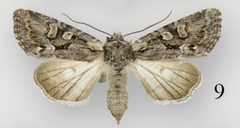
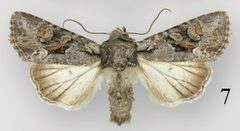
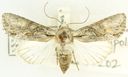
are smaller than Lacinipolia dimocki with duller white hindwings. The forewings are mottled gray or green with reflective . -level identification within Lacinipolia generally requires examination of genitalia or other microscopic features, as visual characteristics alone are insufficient to distinguish closely related species.
Images
Habitat
Occupies diverse environments across western North America, from forests to arid southwestern regions. Larval is ground-level, with caterpillars dwelling in soil or leaf litter.
Distribution
Western North America from southern Yukon and Northwest Territories south to Texas, Arizona, and California. Extends eastward across the southern region to Quebec. Probable occurrence in northern Mexico.
Seasonality
recorded from June to July, with a second from late September to October in Arizona, New Mexico, and Texas. Timing varies across the broad geographic range.
Diet
Larvae are , feeding on multiple plant . Specific plants are not documented.
Life Cycle
Complete with , larva, pupa, and stages. Larvae are ground-dwelling. Specific details of site and stage are not documented.
Behavior
are and attracted to light. Two seasonal peaks in adult activity occur in southern portions of the range, suggesting partial bivoltinism. Daytime resting posture likely involves cryptic positioning on tree bark or lichen-covered surfaces, as observed in related Lacinipolia .
Ecological Role
Larvae function as herbivores in ground-level . serve as prey for including bats and birds. The contributes to nutrient cycling through larval feeding on decaying plant matter and living vegetation.
Human Relevance
No documented economic impact. occasionally observed at light traps during surveys. Not known to be a pest of agricultural or ornamental plants.
Similar Taxa
- Lacinipolia dimockiLarger size and brighter white hindwings distinguish L. dimocki from L. sareta
More Details
Taxonomic Note
Lacinipolia sareta was originally described as Mamestra sareta by Smith in 1906. The is currently classified in the tribe Eriopygini within Noctuinae.
Identification Challenge
The Lacinipolia contains numerous similar that are difficult to distinguish by external appearance alone. Dissection and examination of genitalia is typically required for definitive identification.