
Lacinipolia dimocki
Schmidt, 2015
Lacinipolia dimocki is a small owlet moth in the Noctuidae, described by Schmidt in 2015. It occurs along the Pacific coast from Washington to southern California. are active from mid-August to late September and are attracted to light. The was named in honor of Thomas E. Dimock for his contributions to the study of southern California .
Pronunciation
How to pronounce Lacinipolia dimocki: //læˌsɪnɪˈpoʊliə dɪˈmɒki//
These audio files are automatically generated. While they are not always 100% accurate, they are a good starting point.
Identification
Distinguished from other Lacinipolia by combination of pale grey forewing ground color, incomplete or absent antemedial and postmedial lines, crisp black basal dash, and pale hindwings with limited dark shading (especially in males). The double antemedial and postmedial lines with pale infill, when present, and the specific pattern of the and spots aid separation from . Examination of genitalia may be required for definitive identification.
Images
Appearance
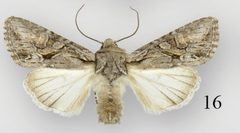
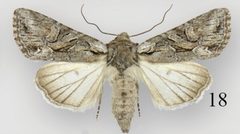
Small with forewings 14.2–15.8 mm in males, 13.8–16.9 mm in females. Forewing ground color pale grey with medial area pale grey-brown. Antemedial and postmedial lines incomplete or absent, when present best developed toward anal margin and fading toward ; antemedial line double with slightly paler grey infill. Postmedial line double, often forming pale indistinct crescent opposite claviform spot. Subterminal area with diffuse dark shading in subapical and anal areas, latter sometimes with small white crescent. Basal dash black and crisp. spot slightly oblong to slightly kidney-shaped with incomplete thin black border, interior slightly paler than ground color. spot with incomplete thin black border, interior slightly paler with indistinct darker inner ring. Male hindwings bright, slightly pearlescent white with terminal third of and thin diffuse margin fuscous. Female hindwings duller white with more extensive fuscous shading on veins and marginal area.
Distribution
Eastern slope of the Washington Coast Ranges to southern California.
Seasonality
recorded on wing from mid-August to late September.
Diet
Larvae probably on herbaceous plants.
Life Cycle
Larvae probably ground-dwelling.
Behavior
attracted to light.
Similar Taxa
- Lacinipolia spp.Other in the share general appearance as small, greyish owlet moths; specific wing pattern details and genitalia examination required for separation.
More Details
Etymology
Named in honor of Thomas E. Dimock for his contributions to the knowledge of southern California .