
Caradrina clavipalpis
(Scopoli, 1763)
Pale Mottled Willow
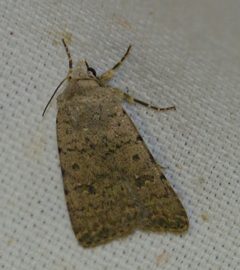
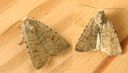
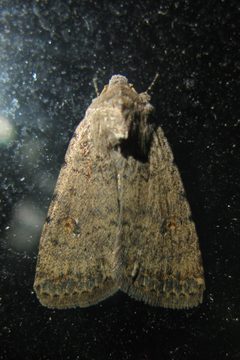
Caradrina clavipalpis, the pale mottled willow, is a small noctuid native to the Palearctic region and introduced to North America since 1993. are attracted to light and sugar, and feed at flowers. The has two per year in temperate regions, with adults flying from April to October depending on location. Larvae feed on cereal grains and plantains, and pupate underground in robust cocoons.
Pronunciation
How to pronounce Caradrina clavipalpis: //ˌkærəˈdraɪnə ˌklævɪˈpælpɪs//
These audio files are automatically generated. While they are not always 100% accurate, they are a good starting point.
Identification
Distinguished from similar Caradrina by combination of: pearly white hindwing (not uniformly grey); small fuscous stigmata with distinctive white dot pattern on ; black costal spots on forewing; and overall pale to dark grey forewing coloration with dentate outer line. Form leucoptera with dark suffusion on forewing but retained white hindwing may cause confusion with other dark noctuids, but hindwing color remains diagnostic.
Images
Habitat
Grassland and gardens; also found in agricultural areas where cereal crops are grown.
Distribution
Native to : Europe, North Africa (Algeria, Morocco, Tunisia, Libya, Egypt), Middle East (Kuwait, Iraq, Iran, Afghanistan), Central Asia, Russia, Mongolia, Pakistan, north-west India, and Sri Lanka. Introduced to North America: first reported Queens, New York City 1993; established and spreading, recorded in Rochester, New York by 2009. Resident in British Isles with boosted by immigration; declined in Scotland and northern England but stable overall in Britain.
Seasonality
fly from April to October depending on location. Two per year in UK: May–July and August–October. Two generations per year in North America.
Diet
feed on sugar and at flowers. Larvae feed on grain of cereal crops (Gramineae) in fields and storage, and on plantains (Plantago spp.).
Host Associations
- Plantago spp. - larval food plant
- Gramineae (cereal crops) - larval food plantgrains in fields and storage
- Cheletomorpha lepidopterum - mite found infesting in hay bales
Life Cycle
Two per year in temperate regions. Larvae pupate in autumn in robust underground cocoons and emerge in spring; early generation gives rise to second generation later in year. occurs as pupa.
Behavior
attracted to light and sugar. Adults recorded in large numbers on nights with known influxes of migrants. activity.
Human Relevance
Larvae feed on stored cereal grains, potentially causing economic damage in grain storage facilities. Subject of sequencing as part of Darwin Tree of Life Project (genome assembly 474 Mb, 98.8% BUSCO completeness).
Similar Taxa
- Caradrina morpheus (Mottled Rustic)Similar size and general appearance, but C. clavipalpis has pearly white hindwing versus greyish hindwing in C. morpheus; also differs in forewing pattern details
- Other Caradrina speciesC. clavipalpis distinguished by combination of white hindwing, small fuscous stigmata with white dots, and black costal spots
More Details
Genome sequencing
sequenced as part of Darwin Tree of Life Project. Assembly: 474 Mb span, 31 chromosomal pseudomolecules (30 + Z ), complete mitochondrial genome 15.6 kb, 98.8% BUSCO completeness. Specimen from Wytham Woods, Berkshire, UK.
Taxonomic note
Some authors treat Paradrina as full rather than synonym of Caradrina, leading to alternative names Paradrina clavipalpis or Caradrina (Paradrina) clavipalpis.