
Caradrina morpheus
(Hufnagel, 1766)
Mottled Rustic
Caradrina morpheus, the Mottled Rustic, is a noctuid with a broad Palearctic distribution spanning northern Europe to Siberia, Amur, and Korea, with additional records in Armenia and Turkestan. The was accidentally introduced to eastern and western Canada, where it has established from New Brunswick to Ontario in the east and in British Columbia in the west. fly in a single from mid-May to August in western Europe, though timing varies regionally. The larvae feed on herbaceous plants including nettle and dandelion.
Pronunciation
How to pronounce Caradrina morpheus: //kəˈrædrɪnə ˈmɔːrfiːəs//
These audio files are automatically generated. While they are not always 100% accurate, they are a good starting point.
Identification
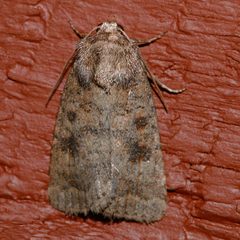
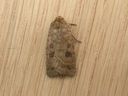
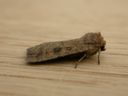
Diagnostic features include: forewings pale brown to darker brown with possible appearance; darker stigmata clearly defined; antemedian line dentate; postmedian line poorly defined; subterminal line pale with darker mottled suffusion; termen with dark lunules between ; hindwings pale glossy white with small discal spot. Distinguished from similar Caradrina by the combination of dentate antemedian line, poorly defined postmedian line, and the pale glossy white hindwing with small discal spot.
Images
Appearance
Wingspan 32–38 mm; forewing length 13–16 mm. Forewing dull dark fuscous with greyish tinge, variable from pale brown to darker brown with possible appearance. Inner and outer lines obscure, double, with arms widely separated. Subterminal line grey with dark suffusion on inner side. and stigmata cloudy fuscous, the latter with slight fulvous stain on outer edge at middle. Hindwing dull whitish to pale glossy white with small discal spot; cellspot, toward termen, and slight subterminal line grey.
Distribution
Native range: Palearctic, from northern Europe across Siberia to Amur and Korea; also Armenia and Turkestan. Introduced range: eastern Canada (New Brunswick to Ontario) and western Canada (British Columbia), where established through accidental introduction.
Seasonality
Single ; fly from mid-May to August in Belgium and the Netherlands. timing varies in other parts of the range.
Diet
Larvae feed on various herbaceous plants including nettle (Urtica) and dandelion (Taraxacum). feeding habits not specified.
Host Associations
- Urtica - larval food plantnettle
- Taraxacum - larval food plantdandelion
Life Cycle
Single-brooded (). Larva greyish brown or dark brown with paler line bearing dark irregular edges; row of blackish sagittate (arrowhead-shaped) markings; darker spiracular line; brown with dark speckling. details not specified.
Human Relevance
Accidentally introduced to Canada, where it has established on both east and west coasts. Not known to cause significant economic or ecological impact.
Similar Taxa
- Other Caradrina speciesshare general 'rustic' appearance; distinguished by specific wing pattern details including dentate antemedian line, poorly defined postmedian line, and pale white hindwing with small discal spot
More Details
Nomenclature
Originally described as Phalaena morpheus by Johann Siegfried Hufnagel in 1766.
Regional variation
season data from Belgium and the Netherlands; timing may differ in other parts of the native and introduced ranges.