
Bellura densa
Walker, 1865
Pickerelweed Borer Moth
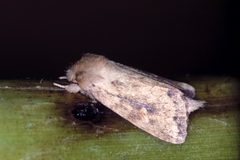
Bellura densa, commonly known as the pickerelweed borer , is a noctuid moth native to eastern and southeastern North America. The species is notable for its aquatic or semi-aquatic larval , with caterpillars that bore into and feed on wetland plants. are medium-sized moths with a wingspan of 35–50 mm. The species is associated with freshwater wetland and has been documented from Maryland to Florida and west to Indiana and Louisiana.
Pronunciation
How to pronounce Bellura densa: /bɛlˈjʊəɹə ˈdɛnsə/
These audio files are automatically generated. While they are not always 100% accurate, they are a good starting point.
Identification
The can be distinguished from other Bellura species by its association with pickerelweed (Pontederia) and other specific wetland plants. The combination of geographic range (primarily southeastern United States) and specificity may aid in identification, though detailed diagnostic morphological features for separating B. densa from are not provided in available sources.
Images
Habitat
Freshwater wetlands, marshes, and aquatic environments. Larvae inhabit and feed on emergent aquatic vegetation. The is specifically associated with wetland plant including those dominated by Pontederia, Typha, and Eichhornia.
Distribution
Eastern and southeastern United States. Documented from Maryland south to southern Florida, west to Indiana and Louisiana. GBIF records confirm presence in North America.
Seasonality
period is not explicitly documented in available sources. As a noctuid in temperate to subtropical regions, activity likely occurs during warmer months, though specific timing requires further documentation.
Diet
Larvae feed on various wetland plants, specifically including Pontederia (pickerelweed), Typha (cattail), and Eichhornia (water hyacinth) . feeding habits are not documented.
Host Associations
- Pontederia - larval food plant pickerelweed
- Typha - larval food plantcattail
- Eichhornia - larval food plantwater hyacinth
Life Cycle
Complete with , larval, pupal, and stages. Larvae are stem borers in aquatic or semi-aquatic plants. Specific details on site (whether aquatic or terrestrial) and number of per year are not documented in available sources.
Behavior
Ecological Role
Larvae function as herbivores in freshwater wetland , consuming living plant tissue of emergent macrophytes. The contributes to nutrient cycling in wetland and serves as potential prey for aquatic and terrestrial .
Human Relevance
The has potential significance in contexts, as larvae feed on water hyacinth (Eichhornia crassipes), a problematic aquatic weed. The reflects its association with pickerelweed, a native wetland plant.
Similar Taxa
- Bellura gortynoidesAlso an aquatic with similar and preferences; distinguished by larval plant associations and geographic distribution
- Bellura melanopygaAnother aquatic Bellura that feeds on Nymphaea; distinguished by plant specificity
More Details
Aquatic Adaptations
Bellura densa belongs to a group of approximately 800 aquatic and semi-aquatic worldwide. Like other aquatic caterpillars, larvae obtain oxygen through periodic surfacing or specialized respiratory adaptations, though specific mechanisms for B. densa are not documented.
Taxonomic History
Originally described as Arzama densa by Walker in 1865, the was later transferred to the Bellura. The basionym Arzama densa is recognized in NCBI records.
Sources and further reading
- BugGuide
- Wikipedia
- GBIF taxonomy match
- iNaturalist taxon
- NCBI Taxonomy
- Catalogue of Life
- William Hazeltine II: His Passion, His Work Live On | Bug Squad
- The Lepidopteran Life Aquatic
- The (almost) Florida-endemic Cicindelidia scabrosa | Beetles In The Bush
- Photographing the Newly Rediscovered Cicindelidia floridana | Beetles In The Bush
- ID Challenge #10 | Beetles In The Bush
- Bug Eric: November 2011