
Oligia strigilis
(Linnaeus, 1758)
Marbled Minor
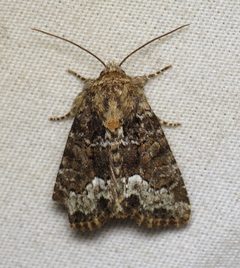
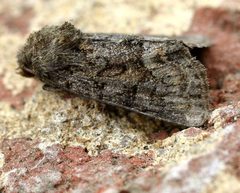
Oligia strigilis, the Marbled Minor, is a noctuid distributed across Britain, Europe, and Central Asia, with accidental introduction and rapid spread in northeastern North America. It is one of three similar Oligia in the UK that require genitalia examination for reliable identification. The species has declined by 76% in Britain since the 1970s despite potential range expansion. Melanic forms occur frequently and have been of significant evolutionary interest.
Pronunciation
How to pronounce Oligia strigilis: /ˈo.lɪ.d͡ʒi.ə ˈstrɪ.d͡ʒɪ.lɪs/
These audio files are automatically generated. While they are not always 100% accurate, they are a good starting point.
Identification
One of three similar Oligia in the UK (with O. fasciuncula and O. versicolor) that cannot be reliably separated by external alone; genitalia examination is required for safe identification. Melanic forms are frequent, showing variable dark coloration patterns.
Images
Habitat
Grassland environments. Larvae inhabit grass stems, moving between stems during development. Found at elevations exceeding 1500 meters in the Alps.
Distribution
Native range: Britain (widespread, scarce in Ireland), throughout Europe, east through the Palearctic to Central Asia and the Altai Mountains. Introduced range: Northeastern North America, where it spread rapidly after accidental introduction.
Diet
Larval stage feeds within grass stems, moving between stems. Has been observed to periodically become a pest of Cock's-foot Grass (Dactylis glomerata) in Germany and Romania.
Host Associations
- Dactylis glomerata - larval Periodic pest of this forage grass in parts of Europe
Behavior
; collected using light traps. Abundance has decreased markedly in Britain by 76% since the 1970s, though distribution has potentially increased. Melanic forms are frequent; patterns of melanism have been of great interest and suggested to have evolved independently in different locations.
Ecological Role
Grass-feeding ; periodically reported as pest of forage grass .
Human Relevance
Periodically becomes a pest of Cock's-foot Grass (Dactylis glomerata), an important forage grass. Subject of monitoring in Britain due to marked decline. sequenced as part of the Darwin Tree of Life project.
Similar Taxa
More Details
Genome
assembly: 626.1 Mb with 31 chromosomal pseudomolecules including the Z ; mitochondrial genome: 15.35 kb. Sequenced as part of the Darwin Tree of Life project.