
Mesapamea secalis
(Linnaeus, 1758)
common rustic
Mesapamea secalis, the common rustic, is a noctuid found across Europe, north-west Africa, Turkey, and northern Iran. It was first described by Linnaeus in 1758 and was formerly treated as with Mesapamea didyma and M. remmi, all three now recognized as distinct . fly from July to August, with larvae feeding on grass stems.
Pronunciation
How to pronounce Mesapamea secalis: /ˌmɛsəˈpiːmiə səˈkɑːlɪs/
These audio files are automatically generated. While they are not always 100% accurate, they are a good starting point.
Identification
Distinguished from Mesapamea didyma (lesser common rustic) and M. remmi (Remm's rustic) by genitalia characters; see Townsend et al. for diagnostic details. External highly variable and unreliable for separation from these . The black-brown streak along the submedian fold, when present, is a useful but not definitive field mark.
Images
Appearance
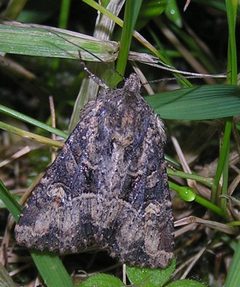
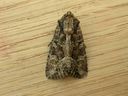
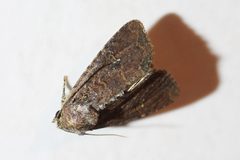
Wingspan 27–30 mm. Forewing highly variable in ground colour: bluish white, cream white, pale to dark grey, ochreous, brownish-tinged, grey brown, red-brown, or purplish brown. and terminal areas darker, fuscous brown to blackish brown. Broad black-brown streak often present from below claviform stigma along submedian fold to outer line. Black dash from base below ; black streak above inner margin near base. Inner and outer lines double, dark, conversely lunulate-dentate. Submarginal line pale with narrow dark shading preceding it. Claviform stigma small, black-edged. oblique, oval, ground-coloured often tinged , with paler annulus and black outline. with brown lunule on inner side, filled with ground colour, luteous, or white. Hindwing fuscous.
Habitat
Grassland including agricultural areas, meadows, and coastal dunes. Associated with stands of larval grasses.
Distribution
Europe, north-west Africa, Turkey, and northern Iran.
Seasonality
on wing July to August; timing varies by location.
Diet
Larvae feed internally on stems of various grasses: Phleum, Alopecurus, Triticum aestivum (wheat), Secale cereale (rye), Elytrigia repens, Elymus arenarius, Dactylis glomerata, and Festuca arundinacea.
Host Associations
- Phleum - larval
- Alopecurus - larval
- Triticum aestivum - larval wheat
- Secale cereale - larval rye
- Elytrigia repens - larval
- Elymus arenarius - larval
- Dactylis glomerata - larval
- Festuca arundinacea - larval
Life Cycle
Larva greenish with double reddish line and yellow spiracular line; black; pale brown. details not documented in sources. emerge July–August.
Ecological Role
Larval stem-borer in grasses; occasional pest of cereal crops including wheat and rye.
Human Relevance
Occasional pest of wheat and rye crops due to larval stem-boring. Subject of taxonomic confusion with related until recent revision.
Similar Taxa
- Mesapamea didymaFormerly treated as ; distinguished by genitalia, external unreliable
- Mesapamea remmiFormerly treated as ; distinguished by genitalia, external unreliable
Misconceptions
Long treated as a single encompassing M. didyma and M. remmi; all three are now recognized as distinct species based on genital .
More Details
Taxonomic history
Elevated to status following recognition that M. secalis, M. didyma, and M. remmi represent distinct biological species. External is highly variable and overlapping among the three, necessitating genital dissection for reliable identification.
Colour forms
Numerous named colour forms described including ab. l-niger (pale ground colour), ab. oculea (pale ochreous with dark costal and terminal areas), ab. furca ( suffusion), ab. rava (rufous ochreous to brown), ab. grisea (unicolorous grey), ab. reticulata (dull brown-grey), ab. nictitans (deep brown), ab. leucostigma (black with obscured markings), ab. pulverosa (dark, clouded, irrorated with whitish ), and ab. lilacina (lilac-grey ground colour).