
Euphyes conspicua
Edwards, 1863
Black Dash
Euphyes conspicua, commonly known as the Black Dash, is a in the Hesperiidae. It occurs in the upper Midwest and central Atlantic regions of North America, specializing in shrubby wetland . The has a single , with active from June through August. Larval development depends on sedges in the Carex.
Pronunciation
How to pronounce Euphyes conspicua: //ˈjuːfi.eɪz kənˈspɪkjuə//
These audio files are automatically generated. While they are not always 100% accurate, they are a good starting point.
Identification
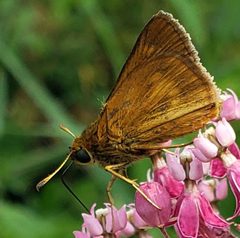
The black dash marking on the forewing provides the primary diagnostic feature and source of the . It can be distinguished from other Euphyes by this marking in combination with its wetland preference and geographic range. The single (June–August) helps separate it from similar species with different periods.
Images
Appearance
Wingspan ranges from 32–42 mm. The refers to a dark dash marking on the forewing, a characteristic feature of this . As a member of Hesperiidae, it has the typical robust body and hooked clubs of . Specific coloration details of wings and body are not documented in available sources.
Habitat
Shrubby or partially wooded wetlands, including sedge meadows and marsh edges. The structure supports both larval plants (Carex ) and nectar sources.
Distribution
Upper Midwest of North America from eastern Nebraska east to southern Ontario, and along the central Atlantic Coast from Massachusetts south to south-eastern Virginia. GBIF records confirm presence in Vermont.
Seasonality
are active from June to August. The has one per year ().
Diet
Larvae feed on Carex stricta and possibly other Carex . feed on nectar from flowers including buttonbush (Cephalanthus occidentalis), jewelweed (Impatiens species), and swamp thistle (Cirsium muticum).
Host Associations
- Carex stricta - larval Primary documented ; other Carex possibly used
- Cephalanthus occidentalis - nectar sourcebuttonbush
- Impatiens species - nectar sourcejewelweed
- Cirsium muticum - nectar sourceswamp thistle
Life Cycle
(one per year). Larval development occurs on sedges, with emerging in early summer. and details are not documented in available sources.
Ecological Role
function as of wetland flowering plants. Larvae are herbivores on sedges, contributing to nutrient cycling in wetland .
Similar Taxa
- Other Euphyes speciesSimilar body plan and preferences; distinguished by forewing markings, geographic range, and period
- Other wetland HesperiidaeShared ; E. conspicua distinguished by the diagnostic black dash marking and specific larval association with Carex
More Details
Subspecies
Three recognized: E. c. conspicua (nominate, Edwards 1863), E. c. buchholzi (Ehrlich & Gillham 1951), and E. c. orono (Scudder 1872). Geographic ranges and distinguishing features of subspecies are not detailed in available sources.
Conservation status
Not formally assessed in major conservation listings. Wetland loss represents the primary potential threat.