
Schinia bimatris
Harvey, 1875
White Flower Moth
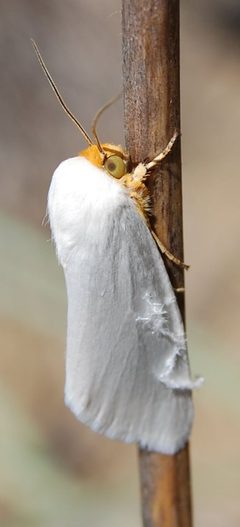
Schinia bimatris, commonly known as the White Flower , is a small noctuid moth found in the south-central and south-eastern United States and in a disjunct in Manitoba, Canada. The species is designated as Endangered under Canada's Species At Risk Act. are distinctive in their entirely white wings, , and with an orange , and have a wingspan of approximately 30 mm. The larval stage remains undescribed, and the plant relationship is poorly understood, though Nuttall's Evening-primrose (Oenothera nuttallii) has been suggested as a possible food source.
Pronunciation
How to pronounce Schinia bimatris: /ˈskɪniə baɪˈmeɪtrɪs/
These audio files are automatically generated. While they are not always 100% accurate, they are a good starting point.
Identification
The entirely white wings and body combined with the orange create a distinctive appearance that separates this from most other North American noctuids. The uniform white coloration without patterning or markings is unusual within the Schinia, which typically includes more colorful and patterned species. The small size (30 mm wingspan) and specific associations (coastal longleaf pine woodlands in the U.S., open sand dunes in Canada) provide additional distinguishing characteristics. The Manitoba is geographically isolated from the main U.S. range.
Images
Appearance
have completely white wings, , and . The is orange. Wingspan is approximately 30 mm (1.2 in). The larval appearance is unknown.
Habitat
In the United States, found in coastal longleaf pine woodlands. In Canada, restricted to open sand dune areas in the Carberry sandhills of Manitoba.
Distribution
South-central and south-eastern United States. Disjunct in the Carberry sandhills, Manitoba, Canada. GBIF records also indicate presence in Saskatchewan, Canada.
Diet
have been observed flying during the day, suggesting possible nectar feeding . The larval food plant has yet to be determined, though Nuttall's Evening-primrose (Oenothera nuttallii) has been suggested as a potential .
Host Associations
- Oenothera nuttallii - possible larval Suggested but not confirmed; larval food plant undetermined
Life Cycle
Larval stage undescribed. stage known. Specific details including number of per year and stage are unknown.
Behavior
are primarily but have been observed flying during the day.
Human Relevance
Designated as Endangered under Canada's at Risk Act and Manitoba's and Act. The Manitoba is of conservation concern due to its restricted range in open sand dune .
Similar Taxa
- Other Schinia speciesMost Schinia exhibit more colorful and patterned wing coloration, often with pink, yellow, or brown markings, and are typically associated with specific plant flowers where they rest and feed.
More Details
Conservation Status
The is listed as Endangered in Canada due to loss and degradation of sand dune . The Manitoba is particularly vulnerable given its geographic isolation.
Taxonomic History
Originally described by Leon F. Harvey in 1875 as Pippona bimatris from specimens collected in Bosque County, Texas by Gustav Belfrage, and later transferred to the Schinia.
Sources and further reading
- BugGuide
- Wikipedia
- GBIF taxonomy match
- iNaturalist taxon
- NCBI Taxonomy
- Catalogue of Life
- Bug Eric: Wasp Wednesday: Not Wasp VIII
- Catch a Glimpse of Caterpillars During National Moth Week
- Bug Eric: White Prairie Clover: An Awesome Blossom
- Bug Eric: Remembering National Moth Week 2018
- Bug Eric: October 2018
- 2013 Oklahoma Collecting Trip iReport | Beetles In The Bush