
Feralia major
Smith, 1890
Major Sallow
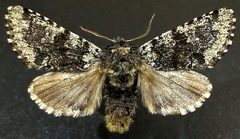
Feralia major is a noctuid with a wingspan of approximately 40 mm. It occurs across the northeastern United States and southern forest of Canada, extending west to Alberta. are active in April, with timing varying by location. The was first described by John Bernhardt Smith in 1890.
Pronunciation
How to pronounce Feralia major: //fɛˈreɪ.li.ə ˈmeɪ.dʒər//
These audio files are automatically generated. While they are not always 100% accurate, they are a good starting point.
Identification
Wingspan of about 40 mm distinguishes it from larger noctuid , though specific diagnostic features for field identification are not documented. from the southeastern United States south to Texas exhibit brighter blue-green coloration and may represent a separate species.
Images
Appearance
Wingspan approximately 40 mm. Coloration and pattern details beyond wingspan are not documented in available sources.
Habitat
Southern forest; northeastern deciduous and mixed forests. Specific microhabitat preferences are not documented.
Distribution
Northeastern United States west across the southern forest to western Alberta, Canada. Records confirmed from Vermont, Manitoba, and Alberta. Southern range boundary uncertain due to potential cryptic in the southeastern US and Texas.
Seasonality
fly in April; exact timing varies by geographic location.
Diet
Larvae feed on Pinus (pines). feeding habits are not documented.
Host Associations
- Pinus - larval food plant-level association; specific pine not identified in available sources
Life Cycle
Complete with , larval, pupal, and stages. Detailed including number of per year and stage are not documented.
Behavior
activity in April. Specific behavioral traits such as mating, oviposition, or larval habits are not documented beyond larval association.
Ecological Role
Larval herbivore on pine trees. Specific ecological impacts or interactions are not documented.
Similar Taxa
- Feralia februalisCongeneric with overlapping range; specific distinguishing characters require examination of genitalia or other detailed morphological features not summarized in general sources
- Southeastern US/Texas populationsBrighter blue-green from southeastern US south to Texas appear to be a separate based on coloration, though not yet formally described as distinct from F. major
More Details
Taxonomic Uncertainty
The southern range boundary of F. major is unresolved. from the southeastern United States through Texas exhibit distinct brighter blue-green coloration and may represent an undescribed cryptic . This requires further taxonomic study to clarify species limits.
Nomenclature
Authorship is properly cited as Smith, 1890 (John Bernhardt Smith, American entomologist).
Sources and further reading
- BugGuide
- Wikipedia
- GBIF taxonomy match
- iNaturalist taxon
- NCBI Taxonomy
- Catalogue of Life
- UC Davis Animal Science Major Ivana Satre Vying for Miss Vietnam Northern California Title | Bug Squad
- Geoffrey Attardo: Growing Presence of This Mosquito: 'A Major Public Health Threat' | Bug Squad
- Meet Andrea Guggenbickler, Outstanding Academic Advisor | Bug Squad
- Marek Borowiec's Awesome Social Insects Award | Bug Squad
- Top Notch Advisors: Elvira Galvan Hack and Robert Kimsey | Bug Squad
- Name That Bug! What About Bob? | Bug Squad