
Acontia cretata
Grote & Robinson, 1870
Chalky Bird Dropping Moth
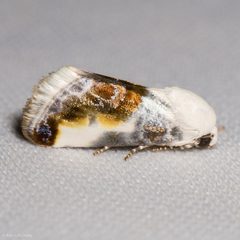
Acontia cretata, commonly known as the Chalky Bird Dropping , is a small noctuid moth with a wingspan of 22–27 mm. It occurs across the southwestern and south-central United States. are active from April to September. The was first described by Grote and Robinson in 1870.
Pronunciation
How to pronounce Acontia cretata: /əˈkɒntiə kriˈteɪtə/
These audio files are automatically generated. While they are not always 100% accurate, they are a good starting point.
Identification
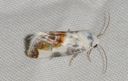
The combination of small size (22–27 mm wingspan), smooth-scaled and without tufts, and the distinctive forewing border with non-crenulate cilia and plain unnotched fringe distinguishes this from similar Acontia. The specific epithet 'cretata' (meaning chalky) likely refers to the pale coloration resembling bird droppings, a common camouflage strategy in this . Separation from other Acontia species requires examination of genitalia or detailed wing pattern analysis.
Images
Appearance
have a wingspan of 22–27 mm. Forewings are bordered with non-crenulate cilia and a plain, unnotched fringe. The exhibits the -level traits of elongated palpi with a pointed frontal tuft, well-developed third palpal segment, and simple lacking branches or complex modifications. and are covered in smooth without tufts or patches. Wing venation shows 7 to 10 stalked.
Distribution
Found in the southwestern and south-central United States, ranging from California east to Texas and Oklahoma, and north to Colorado and Utah.
Seasonality
are on wing from April to September.
Host Associations
- Bracon mellitor - The larva of Acontia cretata has been recorded as a for this braconid .
Life Cycle
Larvae possess four pairs of abdominal , consistent with the lepidopteran ground plan. Specific details of , pupal, and larval stages are not documented.
Similar Taxa
- Other Acontia speciesMany Acontia share the bird-dropping mimicry appearance and similar size range. Accurate identification often requires dissection and examination of genitalia.
- Tarache speciesFormerly classified under Tarache (as T. cretata), these are closely related and share morphological similarities; taxonomic revision has moved some species between these .