
Orgyia leuschneri
Riotte, 1972
Box-elder Tussock Moth
Pronunciation
How to pronounce Orgyia leuschneri: //ˈɔːr.dʒi.ə ˈlɔɪʃ.nɛr.i//
These audio files are automatically generated. While they are not always 100% accurate, they are a good starting point.
Identification
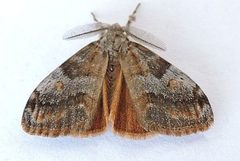
Orgyia leuschneri can be distinguished from other Orgyia by association with its plant, box-elder (Acer negundo). Males have feathery typical of the . Females are wingless with a compact, hairy body. The caterpillars display characteristic tussock features including dense tufts of hair (tussocks) and paired glands.
Images
Habitat
Associated with box-elder (Acer negundo) plants. Found in environments where this tree occurs, including riparian areas, disturbed sites, and urban and suburban settings.
Distribution
North America. Specific range details within this region are not well documented in available sources.
Diet
Larvae feed on box-elder (Acer negundo).
Host Associations
- Acer negundo - larval : box-elder
Life Cycle
Females are wingless and remain on or near their cocoon after , where they emit to attract flying males. are laid on or near the female's cocoon. Larvae progress through instars, feeding on foliage. occurs in a silk cocoon incorporating larval hairs.
Behavior
Females are flightless and sedentary, calling males from their cocoon location. Males are active fliers and locate females using cues.
Human Relevance
The references association with box-elder, a widely distributed North American tree . The species is not documented as a significant pest in available sources.
Similar Taxa
- Orgyia antiquaVapourer , a congeneric with similar wingless female and tussock caterpillar appearance; distinguished by geographic range and plant associations
- Orgyia pseudotsugataDouglas-fir Tussock Moth, a related with similar ; distinguished by association with coniferous rather than box-elder
More Details
Hodges Number
8315
Taxonomic Note
Described by Riotte in 1972. The epithet 'leuschneri' is a patronym, though the honoree is not specified in available sources.