
Dasychira basiflava
(Packard, 1864)
Yellow-based Tussock Moth, yellow-based tussock
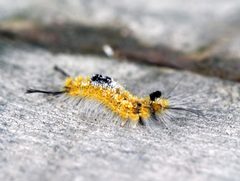
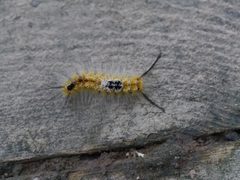
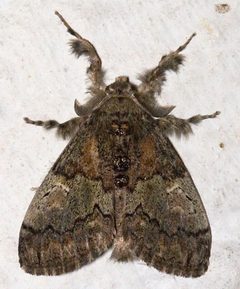
Dasychira basiflava, commonly known as the Yellow-based Tussock , is a of tussock moth in the Erebidae. First described by Alpheus Spring Packard in 1864, this species exhibits pronounced in size, with females substantially larger than males. It is widely distributed across eastern and central North America, with extending from southeastern Alaska to the southern United States. The species shows geographic variation in voltinism, with one per year in northern regions and partial second generations in the south.
Pronunciation
How to pronounce Dasychira basiflava: //ˌdæsɪˈkaɪrə ˌbeɪsiˈfleɪvə//
These audio files are automatically generated. While they are not always 100% accurate, they are a good starting point.
Identification
Distinguished from by the combination of geographic range, , and size dimorphism. The specific epithet 'basiflava' (yellow-based) may refer to a yellow basal wing or body marking, though this requires confirmation. Distinguishing features from similar Dasychira such as D. vagans or D. grisefacta are not documented in available sources.
Images
Appearance
display in wingspan: males measure 30–39 mm, while females are considerably larger at 42–54 mm. As a tussock , adults likely possess the characteristic hairy body and tussock-like tufts typical of the Lymantriinae, though specific coloration and pattern details are not documented in available sources.
Habitat
Associated with forested and woodland containing larval plants: oak (Quercus), dogwood (Cornus), and blueberry (Vaccinium). These host plants indicate occupancy of deciduous and mixed forests, as well as shrub-dominated .
Distribution
North America: Massachusetts and southern Ontario westward to Iowa and Texas, south to South Carolina and possibly Florida. Disjunct in southeastern Alaska.
Seasonality
active June to August in northern portions of range; earlier spring in southern regions. One annually across most of range; partial second generation possible in southern areas.
Diet
Larvae feed on oak (Quercus spp.), dogwood (Cornus spp.), and blueberry (Vaccinium spp.). feeding habits unknown.
Host Associations
- Quercus - larval food plantoak
- Cornus - larval food plantdogwood
- Vaccinium - larval food plantblueberry
Life Cycle
Holometabolous with complete . One per year in northern range; voltinism increases to partial bivoltinism in southern range. Specific details of , larval instars, , and stage not documented.
Ecological Role
Larval herbivore on woody shrubs and trees; contributes to nutrient cycling and serves as prey for . Specific ecological functions not documented.
Similar Taxa
- Dasychira vagansOverlapping geographic range and similar associations; specific distinguishing characters require examination of genitalia or detailed wing pattern analysis
- Dasychira grisefactaSympatric in eastern North America; separation may require close examination of morphological features not summarized in general references
More Details
Taxonomic note
Authority sometimes cited as Packard, 1865, though original description is 1864. Basionym Parorgyia basiflava reflects former placement in Parorgyia before transfer to Dasychira.
Voltinism variation
The shift from to partial across the latitudinal gradient represents a documented case of phenological plasticity in response to thermal regime.