
Hypena palparia
Walker, 1861
Variegated Snout-moth, Mottled Bomolocha, Mottled Snout
Hypena palparia is a medium-sized in the Erebidae, first described by Francis Walker in 1861. The occurs across much of North America, from the Atlantic coast to the Pacific, with active primarily in early summer. Larvae feed on the leaves of specific woody plants including ironwood (Ostrya virginiana) and hazelnuts (Corylus species). The moth is known by multiple reflecting its patterned appearance and snout-like labial palps.
Pronunciation
How to pronounce Hypena palparia: /hɪˈpiːnə pælˈpɛəɹiə/
These audio files are automatically generated. While they are not always 100% accurate, they are a good starting point.
Identification
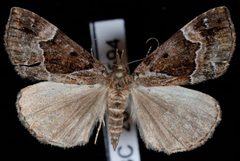
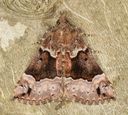
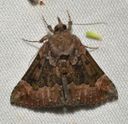
The combination of the snout-like projecting labial palps, variegated forewing pattern, and medium size distinguishes this from most other North American . Within the Hypena, it can be separated from the similar and more common Hypena scabra (green cloverworm moth) by its more distinctly mottled and variegated forewing pattern rather than the relatively uniform brownish-gray of H. scabra. The period in June–July also helps separate it from H. scabra, which has multiple and flies from spring through fall.
Images
Appearance
have a wingspan of 27–33 mm. The forewings display a variegated or mottled pattern of brown, gray, and black tones, providing cryptic coloration against bark and leaf litter. The labial palps are elongated and project forward, creating a distinctive 'snout' appearance characteristic of the Hypena. The body is relatively stout with a furry . Hindwings are typically paler than forewings, usually grayish-brown with less distinct patterning.
Habitat
Deciduous woodlands and forest edges where plants (Ostrya virginiana and Corylus ) occur. are attracted to artificial lights.
Distribution
North America, from Nova Scotia west across southern Canada to British Columbia, and south to Alabama and Texas. Records exist from Alberta, Manitoba, and Saskatchewan in Canada, and throughout the eastern and central United States.
Seasonality
fly from June to July, with timing varying by location. At least two occur over much of the eastern range.
Diet
Larvae feed on leaves of Ostrya virginiana (ironwood, hophornbeam) and Corylus (hazels). feeding habits are not documented.
Host Associations
- Ostrya virginiana - larval Leaves
- Corylus - larval Leaves; unspecified
Life Cycle
At least two per year in the eastern part of the range. Larvae feed on plant leaves. and stages are not explicitly documented in available sources.
Behavior
are and attracted to artificial lights. They rest with wings folded tent-like over the body.
Ecological Role
Larval herbivore on specific woody plants; contributes to nutrient cycling in deciduous forest . may serve as prey for including bats and birds.
Human Relevance
Minor ecological interest; not known to be an agricultural pest. The related Hypena scabra is a significant soybean pest, but H. palparia has no documented agricultural impact.
Similar Taxa
- Hypena scabraSimilar size and snout-like palps, but H. scabra has more uniform brownish-gray forewings without distinct variegation, and flies from spring through fall with multiple
- Other Hypena speciesMany share the snout-like palps and general body form; identification to requires examination of wing pattern details and often genitalia
Sources and further reading
- BugGuide
- Wikipedia
- GBIF taxonomy match
- iNaturalist taxon
- NCBI Taxonomy
- Catalogue of Life
- Soybean Insects: Mid-to-Late Season Pests (V8 to Maturity) - AgriLife Extension Entomology
- green cloverworm (Hypena scabra) - Entomology Today
- A Revision of Soybean Caterpillar Pest Information for U.S. Soybean
- Bug Eric: National Moth Week 2024 Recap from Kansas City
- Bug Eric: Blacklighting Already?
- caterpillar pests of soybean - Entomology Today