
Zale metatoides
McDunnough, 1943
Washed-out Zale Moth, Jack Pine False Looper
Zale metatoides is a in the Erebidae, first described by James Halliday McDunnough in 1943. It is commonly known as the Washed-out Zale or Jack Pine False Looper. The species inhabits barrens and pine woodlands across eastern North America, with a single per year. have a wingspan of approximately 35 mm.
Pronunciation
How to pronounce Zale metatoides: /ˈzeɪli mɛtəˈtoɪdiːz/
These audio files are automatically generated. While they are not always 100% accurate, they are a good starting point.
Identification
The can be distinguished from similar Zale species by its association with jack pine and its more northerly distribution compared to some . The 'washed-out' suggests relatively pale or subdued coloration compared to other zale moths. Accurate identification typically requires examination of genitalia or reference to regional faunal guides.
Images
Appearance
have a wingspan of approximately 35 mm. The exhibits the typical with scaled wings and a compact body form characteristic of the Zale.
Habitat
Inhabits barrens and pine woodlands, particularly those dominated by jack pine (Pinus banksiana). These are open, sandy or rocky with sparse tree cover characteristic of and temperate forest transitions.
Distribution
Found in eastern North America from at least Wisconsin and probably Manitoba eastward to Maine, and south to the mountains of Georgia. Distribution in the Gulf States is uncertain. Records also exist from Saskatchewan.
Seasonality
One per year (). are active during the growing season in their northern range, with specific periods varying by latitude.
Life Cycle
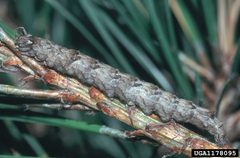
One per year. Larval plant is jack pine (Pinus banksiana), though specific details of , larval, and pupal stages are not well documented in available sources.
Ecological Role
Larvae function as herbivores on jack pine, contributing to nutrient cycling in pine barren . likely serve as prey for insectivorous birds, bats, and other .
Human Relevance
The 'Jack Pine False Looper' reflects its association with an economically important timber . It has no documented significance as a forestry pest. The species is of interest to lepidopterists and naturalists documenting diversity in pine barren .
Similar Taxa
- Zale spp.Other in the Zale share similar and preferences; Z. metatoides is distinguished by its specific association with jack pine and its more northerly distribution in the Appalachian Mountains.
- Lophocampa spp.Tussock moths in the Erebidae may occupy similar pine woodland but differ in larval and appearance.
More Details
Nomenclature
The specific epithet 'metatoides' and 'Jack Pine False Looper' suggest historical taxonomic confusion with loopers (geometrid moths), though it is properly placed in Noctuoidea (Erebidae).