
Catocala verrilliana
Grote, 1875
Verrill's Underwing
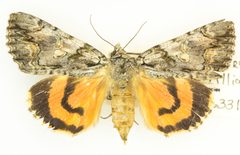
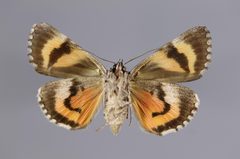
Catocala verrilliana, known as Verrill's Underwing, is a medium-sized underwing in the Erebidae. First described by Augustus Radcliffe Grote in 1875, this occurs in western North America from the Pacific Northwest to the Southwest and southern Great Plains. Like other underwing moths, it exhibits cryptic forewings that conceal brightly colored hindwings, which are revealed when the moth is disturbed. The species has been documented at light stations and sites, though it is often noted as remaining on the periphery of lighted areas rather than approaching directly.
Pronunciation
How to pronounce Catocala verrilliana: //ˌkæ.təˈkeɪ.lə vəˈrɪl.iˌænə//
These audio files are automatically generated. While they are not always 100% accurate, they are a good starting point.
Identification
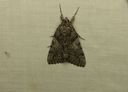
Identified as an underwing ( Catocala) by the characteristic resting posture with forewings folded together over the back, hiding the hindwings beneath. Within the genus, C. verrilliana is distinguished by geographic range and association with specific oak plants. Accurate identification in Catocala typically requires examination of hindwing pattern details, genitalia, or comparison with regional species. It is smaller than some sympatric underwings such as C. aholibah, with which it has been observed at the same light stations.
Images
Habitat
Associated with oak woodlands and mixed forests where oaks occur. Documented from dry mixed conifer forest with oaks at 7,000 feet elevation in New Mexico, as well as riparian areas with cottonwoods and prairie oases in Colorado. The appears to favor supporting its larval host oaks, including Quercus macrocarpa, Q. alba, and Q. garryana.
Distribution
Western North America: from Washington and Oregon east to Colorado, south through California, Arizona, and Texas, and east to Cimarron County in western Oklahoma. The has been specifically documented in Colorado at Cheyenne Mountain State Park and in New Mexico in Grant County.
Seasonality
are on the wing from May to September depending on location. There is probably one per year. Activity peaks during summer months, with records from July events in Colorado and New Mexico.
Diet
Larvae feed on oaks: Quercus macrocarpa (bur oak), Quercus alba (white oak), and Quercus garryana (Oregon white oak/Garry oak). feeding habits are not documented.
Host Associations
- Quercus macrocarpa - larval food plantBur oak
- Quercus alba - larval food plantWhite oak
- Quercus garryana - larval food plantOregon white oak/Garry oak
Life Cycle
Probably (one per year). Larval stage feeds on oak foliage. likely occurs in soil or leaf litter. spans May through September across the range.
Behavior
are and have been observed at light stations, though they typically remain on the periphery of lighted areas rather than approaching lights directly. They have been flushed from trees during nighttime surveys. When disturbed, adults flash their brightly colored hindwings—a startle defense common in underwing moths—before taking .
Ecological Role
Larval stage functions as a folivore on oak trees, contributing to nutrient cycling and serving as potential prey for and . may serve as prey for including bats and birds.
Human Relevance
Subject of citizen science observation during National Week events. Attracts interest from moth enthusiasts due to its status as a western underwing . No documented economic or agricultural significance.
Similar Taxa
- Catocala aholibahLarger sympatric underwing observed at the same light stations in Colorado; distinguished by larger size and different hindwing pattern.
- Catocala amestrisAnother western underwing with overlapping range; distinguished by hindwing pattern and plant preferences.
- Catocala delilahUnusual for southern Colorado region; distinguished by range and morphological features.
More Details
Taxonomic History
The Catocala verrilliana beutenmulleri, described from Utah, is now considered a synonym of the nominate form.
Observation Notes
At a 2017 National Week event at Cheyenne Mountain State Park, Colorado, this was noted as one of two underwing species present, described as the smaller of the two (with C. aholibah likely being the larger). The specimen made a conspicuous entrance, flying erratically around the area before settling— that drew attention from observers.
Sources and further reading
- BugGuide
- Wikipedia
- GBIF taxonomy match
- iNaturalist taxon
- NCBI Taxonomy
- Catalogue of Life
- A Gathering of Lepidopterists: Who's Who of the Butterfly, Moth Experts | Bug Squad
- Got Moths? Celebrate National Moth Week and Global Citizen Science
- Bug Eric: National Moth Week Recap, 2015
- Bug Eric: National Moth Week Recap for Colorado Springs
- Bug Eric: National Moth Week 2024 Recap from Kansas City
- Bug Eric: New Mexico Night Bugs