
Catocala umbrosa
Brou, 2002
Umber Underwing
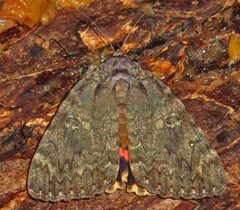
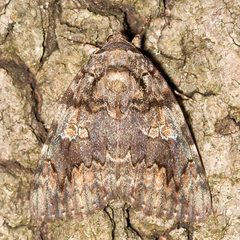
Catocala umbrosa is a North American underwing described by Vernon Antoine Brou Jr. in 2002. are active from April through August with one per year. The occupies a broad geographic range across eastern and central North America.

Pronunciation
How to pronounce Catocala umbrosa: /ˈkætəkələ ʌmˈbroʊsə/
These audio files are automatically generated. While they are not always 100% accurate, they are a good starting point.
Identification
As an underwing in the Catocala, C. umbrosa possesses cryptic, bark-matching forewings that conceal brightly colored hindwings when at rest. Specific diagnostic features distinguishing it from other Catocala are not documented in available sources. The genus is characterized by the distinctive underwing pattern visible only when the moth spreads its wings.
Images
Distribution
Found from Missouri and Louisiana east to Cuba and north through New Jersey to Canada. The iNaturalist record indicates presence across this range with 334 observations.
Seasonality
are on wing from April to August. There is one per year.
Behavior
Underwing moths in the Catocala typically remain on the periphery of light stations rather than approaching lights directly, and may be found resting on tree trunks or foliage near illuminated areas.
Similar Taxa
- Catocala epioneBoth are underwing moths in the same with similar preferences and at light stations, though C. epione has been documented in Kansas while C. umbrosa ranges further east.
- Catocala amestrisAnother underwing attracted to stations in conifer-oak forest ; distinguished by different geographic distribution and hindwing pattern.
- Catocala delilahSimilar underwing found in southern Colorado , recorded at the same location as C. amestris, requiring examination of hindwing patterns for identification.
Sources and further reading
- BugGuide
- Wikipedia
- GBIF taxonomy match
- iNaturalist taxon
- NCBI Taxonomy
- Catalogue of Life
- A Gathering of Lepidopterists: Who's Who of the Butterfly, Moth Experts | Bug Squad
- Got Moths? Celebrate National Moth Week and Global Citizen Science
- Bug Eric: National Moth Week Recap, 2015
- Bug Eric: National Moth Week Recap for Colorado Springs
- Bug Eric: National Moth Week 2024 Recap from Kansas City
- Bug Eric: New Mexico Night Bugs