
Catocala pretiosa
Lintner, 1876
Precious Underwing
Species Guides
1Catocala pretiosa, the Precious Underwing, is a in the Erebidae first described by Joseph Albert Lintner in 1876. It was long treated as a synonym of Catocala crataegi but has been revalidated as a distinct . The nominate is listed as a species of special concern and believed extirpated in Connecticut. are active from May to June with likely one per year.
Pronunciation
How to pronounce Catocala pretiosa: /ˈka.toˌka.la preˈti.o.sa/
These audio files are automatically generated. While they are not always 100% accurate, they are a good starting point.
Identification
Distinguished from the similar Catocala crataegi by genitalic and subtle morphological differences that led to its revalidation as a distinct . Separation from other Catocala species requires examination of hindwing pattern details and genitalia. The two recognized (pretiosa and texarkana) differ geographically rather than by obvious external features.
Images
Appearance
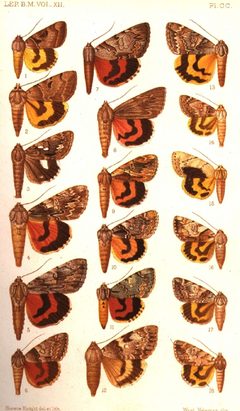
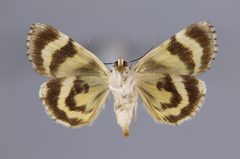
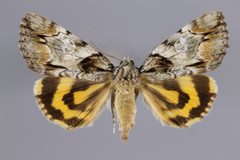
Wingspan 40–50 mm. Forewings are cryptically colored in dull gray-brown tones that provide camouflage against tree bark when at rest. Hindwings are concealed at rest but display bright, striking coloration when exposed—characteristic of underwing moths in Catocala. Specific hindwing pattern details for C. pretiosa are not documented in available sources.
Habitat
Associated with forested and woodland supporting larval plants in the rose (Rosaceae), including serviceberry, hawthorn, apple, and cherry. Specific habitat preferences for are poorly documented.
Distribution
Eastern and central United States: from Massachusetts, Connecticut, and New Jersey west to Pennsylvania, south to Virginia and North Carolina, and west to Tennessee, Louisiana, and Oklahoma. texarkana occurs from Florida to Texas.
Seasonality
on wing from May to June. Probably one per year.
Diet
Larvae feed on Amelanchier (serviceberry), Malus (apple), Photinia arbutifolia (now Aronia arbutifolia, red chokeberry), and Prunus maritima (beach plum). The pretiosa specifically feeds on Amelanchier, Malus, and Aronia arbutifolia.
Host Associations
- Amelanchier - larval food plantServiceberry
- Malus - larval food plantApple
- Aronia arbutifolia - larval food plantRed chokeberry; previously listed as Photinia arbutifolia
- Prunus maritima - larval food plantBeach plum
Life Cycle
Complete with , larval, pupal, and stages. Larvae feed on plants in Rosaceae. details are not documented. Adults emerge in late spring.
Behavior
are . Like other Catocala , they typically rest with forewings folded over the body, concealing the brightly colored hindwings. When disturbed, they may flash the hindwings to startle before taking . They are not strongly attracted to lights compared to some species, often remaining on the periphery of lighted areas.
Ecological Role
Larvae function as herbivores on Rosaceae shrubs and trees. may serve as prey for bats, birds, and other . Specific or prey relationships are not documented.
Human Relevance
The nominate (C. p. pretiosa) is listed as a of special concern and believed extirpated in Connecticut, indicating conservation concern in parts of its range. No significant economic or cultural importance is documented.
Similar Taxa
- Catocala crataegiLong treated as ; distinguished by genitalic and subtle morphological features that led to revalidation of C. pretiosa as distinct
- Other Catocala speciesShare the underwing bauplan with cryptic forewings and brightly patterned hindwings; require examination of hindwing pattern and genitalia for definitive identification
More Details
Taxonomic history
Catocala pretiosa was first described by Lintner in 1876 but was subsequently treated as a synonym of Catocala crataegi by many authors. Recent taxonomic work has revalidated it as a distinct based on morphological differences.
Subspecies
Two are recognized: Catocala pretiosa pretiosa (northeastern and central US) and Catocala pretiosa texarkana Brower, 1976 (Florida to Texas). The Texarkana Underwing subspecies was described by Brower in 1976.
Sources and further reading
- BugGuide
- Wikipedia
- GBIF taxonomy match
- iNaturalist taxon
- NCBI Taxonomy
- Catalogue of Life
- A Gathering of Lepidopterists: Who's Who of the Butterfly, Moth Experts | Bug Squad
- Got Moths? Celebrate National Moth Week and Global Citizen Science
- Bug Eric: National Moth Week Recap, 2015
- Bug Eric: National Moth Week Recap for Colorado Springs
- Bug Eric: National Moth Week 2024 Recap from Kansas City
- Bug Eric: New Mexico Night Bugs