
Catocala lacrymosa
Guenée, 1852
Tearful Underwing

Pronunciation
How to pronounce Catocala lacrymosa: /ˈkætəkələ lækrɪˈmoʊsə/
These audio files are automatically generated. While they are not always 100% accurate, they are a good starting point.
Identification
Distinguished from other Catocala by forewing pattern details and hindwing coloration. The specific epithet 'lacrymosa' refers to tear-like markings. Forewing pattern includes fine dark lines and shadings that differ from such as C. concumbens or C. ilia. Hindwing bands typically orange-red with black borders. Identification to species requires examination of forewing pattern details, as hindwing colors overlap with related species. Genitalia examination may be necessary for definitive identification where ranges overlap with similar species.
Images
Appearance
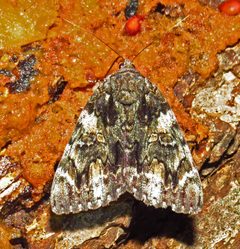
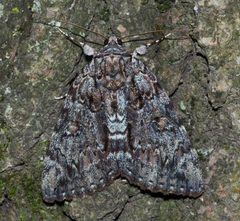
Wingspan 60–82 mm. Forewings gray-brown with intricate dark patterning, providing camouflage against tree bark. Hindwings display the characteristic underwing coloration—typically with orange, red, or yellow bands bordered by black. The specific pattern of the tearful underwing includes markings that suggest 'tear' or 'lacrimal' patterns, referenced in the epithet. Body robust, typical of the .
Habitat
Deciduous and mixed forests where hickory trees (Carya spp.) occur. Associated with mature woodland , particularly those with shagbark hickory and other Carya . often found resting on tree trunks during daylight hours.
Distribution
Eastern North America: Massachusetts and Connecticut south to Florida, west to Texas and eastern Oklahoma, north to Illinois and Michigan, extending into southern Ontario.
Seasonality
active July to September, depending on location. Single per year ().
Diet
Larvae feed on Carya (hickories). feeding habits not well documented; adults of related Catocala species have been observed feeding on fermenting sap, fruit, and other sugary substances.
Host Associations
- Carya - larval plantLarvae feed on hickory
Life Cycle
Complete with , larva, pupa, and stages. Single per year. Larval stage feeds on hickory foliage. occurs in soil or leaf litter. Adults emerge in mid to late summer.
Behavior
are and attracted to light, though often remain on the periphery of light stations rather than landing directly on sheets. When disturbed, adults flash their brightly colored hindwings as a startle defense against , then rapidly fly to seek concealment on another tree trunk. Daytime resting posture with forewings folded over hindwings, concealing the bright colors.
Ecological Role
Larvae function as folivores on hickory trees, contributing to nutrient cycling in forest . serve as prey for including bats, birds, and predatory insects. The startle display of the hindwings may contribute to predator learning and avoidance of similarly patterned prey.
Human Relevance
Subject of interest to lepidopterists and enthusiasts, particularly during National Moth Week events. The Catocala has been spotlighted in citizen science initiatives due to its striking appearance and relative detectability. No significant economic impact documented; larvae do not reach pest status on hickory trees.
Similar Taxa
- Catocala concumbensOverlapping range and similar hindwing coloration; distinguished by forewing pattern details
- Catocala iliaSimilar size and general appearance; forewing pattern and hindwing band configuration differ
- Catocala aholibahLarger with similar preferences; distinguished by size and forewing markings
More Details
Etymology
The specific epithet 'lacrymosa' (Latin for 'tearful') refers to the tear-like or lacrimal markings on the forewings.
Conservation Status
Not formally assessed; appears secure throughout range based on observation records, though dependent on mature hickory forest .
Sources and further reading
- BugGuide
- Wikipedia
- GBIF taxonomy match
- iNaturalist taxon
- NCBI Taxonomy
- Catalogue of Life
- A Gathering of Lepidopterists: Who's Who of the Butterfly, Moth Experts | Bug Squad
- Got Moths? Celebrate National Moth Week and Global Citizen Science
- Bug Eric: National Moth Week Recap, 2015
- Bug Eric: National Moth Week Recap for Colorado Springs
- Bug Eric: National Moth Week 2024 Recap from Kansas City
- Bug Eric: New Mexico Night Bugs