
Catocala clintonii
Grote, 1864
Clinton's Underwing
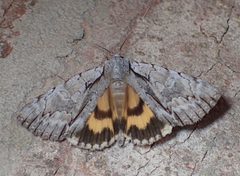
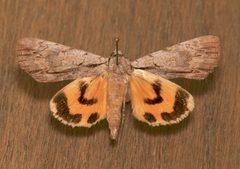
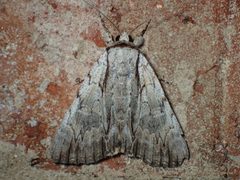
Catocala clintonii, commonly known as Clinton's Underwing, is a of underwing in the Erebidae. It belongs to a renowned for its striking coloration concealed beneath cryptic forewings. The species occurs across eastern and central North America, from Canada south to Florida and west to Texas and Wisconsin. Like other underwings, it exhibits the characteristic resting posture with forewings folded together, hiding the brightly patterned hindwings until disturbed.
Pronunciation
How to pronounce Catocala clintonii: /kætoʊˈkɑːlə klɪnˈtəʊni.aɪ/
These audio files are automatically generated. While they are not always 100% accurate, they are a good starting point.
Identification
Distinguished from other underwing moths ( Catocala) by specific wing pattern characteristics. The forewings are dull-colored, providing camouflage against tree bark when at rest. When wings are spread, the hindwings reveal bold coloration typical of the genus. Positive identification to level often requires examination of wing pattern details, genitalia dissection, or expert confirmation, as many Catocala species exhibit similar appearances and individual variation.
Images
Habitat
Associated with forested , particularly areas with mature trees that provide bark-matching camouflage for daytime resting. The has been documented in dry mixed conifer forest with oaks at elevations around 7,000 feet, as well as in deciduous and mixed woodlands across its range.
Distribution
Eastern and central North America: from Ontario and Quebec in Canada, southward to Florida, west to Texas, and north to Wisconsin. Distribution records also include Manitoba and Saskatchewan in Canada.
Behavior
. are typically reluctant to come directly to lights, often remaining on the periphery of lighted areas or in nearby vegetation. When disturbed, they may flush and fly erratically before settling. The cryptic forewings provide effective camouflage against tree bark during daytime resting.
Ecological Role
likely serve as prey for including bats and birds. Larval stage presumably functions as herbivore, though specific plant relationships remain undocumented in the provided sources. The contributes to overall diversity in forest .
Human Relevance
Subject of interest to lepidopterists and enthusiasts, particularly during National Moth Week events and similar citizen science initiatives. The Catocala has been featured as a spotlight group for public education about moth diversity. Not known to be of economic importance.
Similar Taxa
- Catocala epioneBoth are underwing moths with similar cryptic forewing appearance and concealed colorful hindwings; occurs in overlapping range and shares preferences
- Catocala aholibahAnother large underwing with similar of flying erratically around light stations before settling; requires careful examination of hindwing pattern for differentiation
- Catocala verrillianaSmaller underwing that may co-occur at light stations; distinguished by size and specific wing pattern details
Sources and further reading
- BugGuide
- GBIF taxonomy match
- iNaturalist taxon
- Catalogue of Life
- A Gathering of Lepidopterists: Who's Who of the Butterfly, Moth Experts | Bug Squad
- Got Moths? Celebrate National Moth Week and Global Citizen Science
- Bug Eric: National Moth Week Recap, 2015
- Bug Eric: National Moth Week Recap for Colorado Springs
- Bug Eric: National Moth Week 2024 Recap from Kansas City
- Bug Eric: New Mexico Night Bugs